In 1992, Alan Veingrad, former offensive lineman for the Dallas Cowboys, made all the right moves to protect the quarterback and ward off the other team's advances, helping to secure his team a Super Bowl victory. Today, he's taken that same sense of discipline and strength of will to focus his sights on what he considers a significantly more meaningful "end zone" - observant Judaism.
Born in Brooklyn and raised in Elizabeth, NJ and Miami, FL, Mr. Veingrad says he grew up like most Jews in America -- with a "very secular" background. "We lit candles Friday night and got together with family on Chanukah and holidays," he says. "The focus was mainly on the chicken soup, kugel and latkes." In order to ready their son for the required bar mitzvah celebration, his parents insisted on Hebrew school. "I just didn't connect," he remembers. "After my parents dropped me off, I'd walk in the building and go out the back door. I spent the time throwing stones into a lake."
By 14, he had fulfilled his Hebrew school obligation and devoted his free time to "hanging around with the wrong crowd." He noticed that his older brother, Steve, chose a different route, participating in football, wrestling, basketball, and the track team. "I realized I would get into trouble if I didn't start getting involved in after school activities," he says. Well aware of his then skinny frame, Veingrad promptly approached the school's training coach and asked him to instruct him in weightlifting. Soon thereafter, he went out for the high school football team.
One day, during track & field (discus) practice, Veingrad sensed a compelling need to flex his long atrophied spiritual muscles. "I was starving for inspiration," says Mr. Veingrad. "I sought motivation from tapes and books on winning, to find out how to improve myself, not only as a player, but as a person." That desire would follow him throughout his accomplished football career.
Veingrad went on to attend East Texas State University in Commerce, TX, with classmates hailing from the Bible Belt states -- leaving Veingrad the lone Jew on campus. "Most of my teammates had never met a Jew before," he says. "What little they knew they heard at home and in the movies." When he entered professional football, his teammates came to him with questions around the holiday time. "They asked me why Jews celebrate eight days of Chanukah and told me they read that Jews fast on a particular day and could I tell them why." Because of his limited background, he found himself hard-pressed to answer their inquiries. Throughout all the attempts at proselytizing and pre-game team prayer meetings, he never lost his sense of who he was and wanted to be. "I would say my own silent prayer," says Veingrad. "A Jewish prayer."
After he completed his undergraduate degree, the Green Bay Packers signed him on as a free agent. Upon hearing of the team's solitary Jewish Packer, a family in the Wisconsin Jewish community reached out to Veingrad. "I found a note in my locker that instructed me to phone Lou Weinstein, who turned out to be a local Jewish businessman calling to congratulate me for making the team and to ask if there was anything he could do to help me." The Weinsteins welcomed Veingrad into their home and brought him to their shul for Rosh Hashana. "When I heard the Torah, it connected to something inside me," he says. "Those experiences sustained me during my years with the Packers."
Over his seven professional ball-playing years, aside from some locker room ribbing, Veingrad says he rarely encountered overt anti-Semitism. However, he remembers one disturbing incident. A teammate informed him that he thought all stereotypes were based on truth. Veingrad asked him what he meant. "He said that Jews were cheap," recalls Veingrad. "I told him I'm a Jew so he's calling me cheap, when he knows I always pay my share. I didn't have a good answer for him. But, I do today. Jews are the biggest charity givers in the world. President George Bush recently told an audience from the Republican Jewish Coalition that American Jews single handedly saved the people hit hard by Hurricane Katrina in New Orleans -- with all the money that poured in and the rabbis that came through in the crisis. When I speak around the country, I always talk about this [misconception]."
Prejudice never showed its face with the NFL's professional management. "The ownership and coaches don't care where you're from, what college you went to, or what religion or color you are," says Veingrad. "They only care about three hours on Sunday; that you perform on a level that helps the team win. I never experienced anything other than [the expectation to] work hard. I had to prove myself every single day."
After many months of relentless practice, pressure, meetings, and media exposure, winning the Super Bowl gave Veingrad and his teammates a hard-earned sense of relief. And the end-of-the-season team party offered them an appropriate forum for exuberant congratulations between team members, family and friends. Once the exultation wound down, Veingrad left the party and caught a flight home out of Los Angeles -- to start preparing for the rest of his life.
In 1993, a year into retirement from professional sports, he married and started a family. The Veingrads settled in the Fort Lauderdale section of Florida and soon welcomed Jeri Lauren, their first child, into their lives. "As we are her link to the Jewish past, she is our link to the Jewish future," wrote Veingrad about this joyous event, in a 1995 piece for The New York Times in a piece called, "What Being Jewish Means to Me." The local rabbis fortified that link with Shabbat meal invitations. Once again, the exalted Shabbat atmosphere and inspiring Torah discussions whet his yearnings for a more Jewish life.
Veingrad warily observed how many retired professional athletes fell into debilitating depressions. "All of a sudden they don't know what to do with themselves," he says. "I didn't prepare myself for life after football and went through four years of a difficult transition. One has a lot of energy as an athlete -- going from workout to a game to a practice to a meeting; he's in constant motion. When I stopped playing, I had all this downtime." He says he filled it with golf, fishing, and dabbling in real estate. On the golf course, he met up with a fellow ex-NFLer, Bernie Kosar, a former high-profile quarterback, who offered him a position as sales vice-president in a cooperate company that out-sources customer care. "I immersed myself in the industry," says Veingrad. "I learned the business; doing lots of traveling, preparation and attending meetings." Yet, a familiar internal nudge prompted him to seek out the true, deeper meaning to life.
His cousin and personal radiologist, Dr. Jonathan Rubin, who examined Veingrad's x-rays after each football injury, facilitated that goal with a friendly invitation to an "authentic Shabbat meal" at his Miami Beach home. "He showed me the power of reaching out to a Jew," says Veingrad. "My cousin asked me: 'Alan, will you come to my house for a Shabbos?' And I accepted. Then during the meal he asked me; "Alan, would you go to a Torah class?' I said okay, I'll go to one."
He informed Veingrad of a class given by a "traveling rabbi" who made a regular stop in his neighborhood. He attended the class and found the rabbi's topic particularly inspiring. "He spoke about envy and materialism," recounts Veingrad. "When I lived and breathed football, the guys made lots of money; I didn't relate to that aspect. I owned a pickup truck and lived in a one-bedroom apartment. It wasn't until after I retired that I lived around people who owned huge homes [and whose lives revolved around] vacations, boats, golfing, sports cars. I didn't like it. I realized I couldn't live in an environment in which everyone was a slave to materialism." He sees it as no coincidence that his first Torah class spoke directly to his core beliefs and gave him fuel to take him to the next spiritual step.
The Shabbat experiences and a telling article solidified some consequential decisions concerning Veingrad's life direction. He noticed a piece in The Fort Worth Star Telegram depicting the former NFL lineman's current milieu. "It spoke of my 'busy lifestyle' of kayaking, martial arts, biking, landscaping, and skateboarding with my children," he says. "I read it and thought: 'Something's missing.'" He decided to hold a family discussion about how they would be making some changes in their weekly routine together. "This Friday night, we are going to shul," he began. "And we are going to have Shabbat meals. My family was right behind me."
Veingrad's speaking engagements allow his family to experience Shabbat in communities around the country. When his daughter, Jeri, is asked if she misses the other life, she responds with a self-assured, "Not at all." Veingrad sees Shabbat as 25 precious hours to recharge. "We are pounded six days a week with email and cell phones. Shabbos is so important. I encourage people, who sit at home on Friday night, with the TV, to give themselves a chance to do a real Shabbos in a rabbi's home and compare the two experiences. I assure you they are going to change their lives."
His cousin continues to assist him in his quest to grow in Judaism by offering to learn with him. "He bought me a book and we learn every day," says Veingrad. "This is a very busy doctor with a family, who calls me from the hospital [during a free moment in his hectic workday] and asks me if I have five minutes. Then he says: 'Turn to page...and start reading."
The Veingard children, Jeri, Brooke, and Ryan, currently attend the Hebrew Academy Community School in Margate, FL and continue to admire their foremost mentor, their father. "My children watch me as I go to a corner of the house and quietly put on my tefillin," says Veingrad. "When I announce that it's time to go to shul, they wait at the door. They all feel this is a better life. I had a nice house one half-mile from the beach; I had all these things and didn't feel my life had much meaning. Living a Jewish life has so much more meaning. No one can argue with me; I've lived both lives."
His parents had only positive things to say about their son's turnaround. "Before he passed away, my father called and told me that he's prouder of me with the yarmulke on my head than with a Dallas Cowboy or Green Bay Packer helmet," says Veingrad. "This is a Jew who went to shul [a total of] ten times, all within the last year of his life, because I dragged him with me. He saw what it did for my family." When the Veingrads visit his mother, she gladly accommodates their kosher needs. His older brother, Steve, whose powerful example motivated Veingrad to pursue more productive after school activities back in junior high, is currently reaping the rewards for his favorable influence. He attends local Shabbatonim with his younger brother and has heard him speak. "He told me just a few months ago: 'I was never proud of being Jewish, but I am now.'"
Although Veingrad and his son participate in recreational sports, he doesn't encourage him to follow in his father's cleat-steps. "It is better to learn the Torah, to make something of oneself; not by using one's body," he says. "As a professional player, the body gets pounded. I can still feel its effects."
Veingrad readily admits that he developed his keen discipline and focus from his football days and applies it to Judaism. "Some of the rabbis laugh because I have to get to shul before they start, with tallis and tefillin on, ready to go" says Veingrad. "When Jimmy Johnson, the great football coach, called a meeting at 7:00 a.m., if someone walked in late, he would look at him and say: 'Is there something more important in your life than preparation for a football game? If one takes those extra minutes to prepare oneself, it gives a greater lift to one's davening."
According to Veingrad, when Jews, resistant to becoming more involved in their Judaism, hear his story, they surmise that he was able to change his life around because professional football players can more facilely go from 0 - 60. "I'm not suggesting that everyone should grow as quickly as I did," he says. "I felt this is what I wanted to do. I liked the way the waters felt, so I jumped in with both feet. I didn't like being in that in- between space of okay this week we'll go to shul and next week to Disney World."
In 2004, an Israeli friend from Veingrad's shul approached him and stated: "You're going to go to Israel with me this May." Before boarding the plane, Veingrad placed a yarmulke on his head. While in Israel, he bought tzitzit and davened three times a day. "I was a sponge," he says. "And I was growing." On the way back to Florida, the former football pro found himself tackling an unexpected dilemma. "I've got this yarmulke and tzitzit on me," he thought. "What am I going to do once I get back to the US?" For a few weeks, he tucked the tzitzit in and wore a hat. Feeling increasingly uneasy with that solution, he removed the hat and put his yarmulke back on. It hasn't come off since. "I said: 'This is it! This is who I am.'"
After that long-ago Super Bowl victory party, Alan "Shlomo" Veingrad knew he needed to return home to prepare for the rest of his life. And he did.
Monday, January 29, 2007
Super Bowl Champion to Dad's Champion
A really moving piece about Alan Veingrad's, a former Super Bowl winning offensive lineman, spiritual journey. A good read from aish.com:
Sunday, January 28, 2007
Brothers in Arms
In dedication to our great army, whose soldiers risks their lives on a daily basis to protect the civilians of Israel, here is a nice clip I found on YouTube. They are often slandered, even by their own, but nonetheless continue to do their job with the courage and devotion to the mission at hand.
Friday, January 26, 2007
Dissecting Warrior
 Although I'm only up to 1965 in Ariel 'Arik' Sharon's autobiography, Warrior, the book has already given me such a different understanding of one of Israel's most controversial military and political leaders. From his tough upbringing in Kfar Malal to his rise in the Haganah and the IDF, David Chanoff narrates a fast paced book with Sharon's in-depth descriptions of some of the major battles and operations that shaped Israel's struggle to survive. I have found that as I progressed through the book, I have come to respect Sharon more and more but at the same time, it has also left me with many questions regarding the Sharon that led Israel over the last few years.
The book's first few chapters detail Sharon's upbringing in Kfar Malal, a small moshav near the modern cities of Kfar Saba and Ra'anana. The hardships he talks about are the 'usual' ones we read about from this era - difficulty with cultivating the land and the increasingly violent relationship with the Arabs. However, Sharon focuses more on how his father was always an outcast for try ing to grow new vegetables and fruits on his patch of land. Despite constant objections from the moshav, Samuil Sharon continued to follow his ideas and develop fruits, which nowadays are grown throughout Israel. Easy to see where Arik's ability to always stay true to his beliefs (be it the settlements or the disengagement) comes from. Sharon also candidly opens up about his relationship with Gali, the woman that would become his first wife and would tragically pass away in a car accident within five years of giving birth to Gur, their first son. Reading these chapters is always 'difficult' as the Israel Sharon describes is the Israel I would have loved to be a part of - a young, passionate, hard working and ideological people building a country from scratch.
From the moment Sharon turns 17, the book starts following Sharon's rise in the Haganah, his commanding of Unit 101 and his leading of the Paratroopers, who were responsible for every mission in those years. A few interesting things that are worth mentioning involve the Palmach and Latrun.
- The Palmach was the premier force within the Hagnah and Sharon never even attempted to enlist with them. His reasoning was his father, who begged him to never join any group that betrays the Jewish people, as the Palmach did so proudly during The Season (handing over Irgun and Lechi fighters to the British).
- The battle for Latrun was the most costly of all the battles fought during the 1948 Independence Day War. Sharon's unit was amongst those who were decimated during one of the numerous attacks launched on the Jordanian held fort. Sharon's unit was left alone, while other retreated, due to lack of communication between the units and the commanding officers (who were not on the battle field). With the help of others, the seriously injured Sharon managed to retreat with all his injured troops and the dead. Mostly due to his event, Sharon would stress, and rightly so, throughout his army career that the single most important element of the army is to never leave any soldiers behind. Any soldier who thinks for a second that he might be left behind during battle will not fight with his maximum abilities.
The above points raised difficult questions for me. If Sharon wouldn't join the Palmach due to his father's advice, why then when he decided on the disengagement did he not make the adjustment to life out of Gaza easier on the evicted? The harsh realities they're facing now have left many feeling as if they were betrayed by their government. What changed in Sharon that allowed him to at least not ensure that once their towns were destroyed, those that were moved would have a good opportunity to try and rebuild their lives wherever they were moved to? The next few questions have been bothering me for years. When 3 soldiers were kidnapped and killed by Hezbollah in 2000, why did Sharon not command the army to launch an operation to retrieve their bodies? Why did Sharon not take a document signed by 112 MKs (members of the Israeli Parliament) to George Bush asking for the release of Jonathan Jay Pollard? There are many more questions likes these that a man who stressed that 'a soldier should never be left behind' should have never left unanswered (perhaps they will be answered later on in the book)
 As I've only reached 1965, I really cannot comment on other interesting aspects of Sharon's life. I'm looking forward to reading his take on the Six Day war, the Yom Kippur war (which Sharon is credited for turning around with his remarkable demolition of the Egyptian army) and the Sabra & Chatilla massacre (which Sharon has been blamed for till this very day). Until then, I will leave you with one quote that has struck out to me from the book. On his deathbed, Samuil Sharon told his 28 year old son, "It's a pity I'm going to die. You still need my help in so many ways." Sharon comments on his disbelief at the statement, and how later on in his life, he realized how right his father was. It's quite a simple lesson for all of us to really learn. Our parents are a fantastic source of information and understand us far better than most. We should take advantage of that while we have the chance ...
Wednesday, January 17, 2007
The End of Borat

After the incredible success of Borat: Cultural Learnings of America for Make Benefit Glorious Nation of Kazakhstan, Sacha Baron Cohen has decided to end the career of the fictional Kazakh report, Borat. Due to the movie's success worldwide, Cohen acknowledges that it would be "impossible to do Borat again." With his fame reaching such high levels, it seems that it would be highly unlikely for Borat to ever do something unscripted again. So unfortunately, it seems to be the right time to end one of the funniest characters I've ever seen ...
This is one of my favorite Borat moments:
Jak sie masz? My name-a Borat. I like you. Chenkwee!
Well I'll be 'Dan'ned
The aftermath of the Yom Kippur war (1973) forever changed Israel. Despite winning the war, the Israeli public had its self confidence severely shaken by an army that did not seem prepared for the war. With over 2000 dead and 4000 injured, there was major doubt cast upon the competence of the Labor elite, who had been ruling the country since 1948. Although the public was especially critical of defense minister Moshe Dayan, the Agranat Commission wrongly laid the blame on IDF Chief of Staff David 'Dado' Elazar's shoulders. This despite the fact that prime minister Golda Meir was warned by army intelligence of a potential strike, as well as also receiving a 'delivered in person' warning from King Hussein of Jordan days before the war. Golda Meir, who actually accepted full responsibility for the debacle (In her autobiography, Meir expresses extreme remorse for not authorizing a preemptive strike similar to that of 1967), would resign the next year and within a few years, Israel's political establishment would forever change with the Likud's Menachem Begin being elected as prime minister.
Fast forward to July/August 2006 and Israel is embroiled in a month long war with Hezbollah. Despite Ehud Olmert outlining the goals of the war as being the return of the kidnapped soldiers (2 from Lebanon and 1 from Gaza) and the ending of Quassam rockets from Gaza, neither target is achieved. The Israeli public again loses faith with its army and government. The government-appointed Winograd committee is set up to determine responsibility for the wartime debacle. And that brings us to today, where the headlines this morning finally read, 'IDF Chief of Staff Dan Halutz announces his resignation.' It's not that I'm happy, but I'm relieved that someone is finally accepting responsibility for the pathetic way our country was run during the war. This however, should only be the first stage of what needs to be a major shake up for this country.
 Dan Halutz was the first pilot and non infantry soldier to be given the honor of being Chief of Staff. He was appointed by Ariel Sharon to replace Moshe 'Bugi' Yaalon, who was fired for rightly speaking out against the disengagement. It seemed to many that Sharon's reasoning for picking this decorated pilot were more due to political considerations than military ones. Halutz supported the disengagement and never spoke against it, despite the army's warnings of what would happen if we were to leave Gaza in the planned manner. In 2 years, he did little to improve the army and when confronted with the major challenge of war, it seems that he had no clear objective to help achieve the stated goals of the war. In his letter of resignation to Olmert, Halutz wrote:
Exactly what he's proud of, I don't know. I just hope that a strong candidate replaces him who can reinvigorate our army, and prepare her for any potential future challenges that lie ahead of her. Halutz has made the right decision, and for the sake of the country, I hope Olmert and defense minister Amir Peretz follow in his footsteps ...
Fast forward to July/August 2006 and Israel is embroiled in a month long war with Hezbollah. Despite Ehud Olmert outlining the goals of the war as being the return of the kidnapped soldiers (2 from Lebanon and 1 from Gaza) and the ending of Quassam rockets from Gaza, neither target is achieved. The Israeli public again loses faith with its army and government. The government-appointed Winograd committee is set up to determine responsibility for the wartime debacle. And that brings us to today, where the headlines this morning finally read, 'IDF Chief of Staff Dan Halutz announces his resignation.' It's not that I'm happy, but I'm relieved that someone is finally accepting responsibility for the pathetic way our country was run during the war. This however, should only be the first stage of what needs to be a major shake up for this country.
Dan Halutz was the first pilot and non infantry soldier to be given the honor of being Chief of Staff. He was appointed by Ariel Sharon to replace Moshe 'Bugi' Yaalon, who was fired for rightly speaking out against the disengagement. It seemed to many that Sharon's reasoning for picking this decorated pilot were more due to political considerations than military ones. Halutz supported the disengagement and never spoke against it, despite the army's warnings of what would happen if we were to leave Gaza in the planned manner. In 2 years, he did little to improve the army and when confronted with the major challenge of war, it seems that he had no clear objective to help achieve the stated goals of the war. In his letter of resignation to Olmert, Halutz wrote:"For me, the word responsibility has great meaning. My view of responsibility is what led me to remain in my post until this time and to place this letter on your desk today...Since the echoes of battle ceased, I decided to act responsibly according to the best traditions and values from home and from my service in the IDF. I feel proud that I completed what I set out to do. After these thorough processes, I am sure the IDF will be ready to meet the challenges ahead."
Exactly what he's proud of, I don't know. I just hope that a strong candidate replaces him who can reinvigorate our army, and prepare her for any potential future challenges that lie ahead of her. Halutz has made the right decision, and for the sake of the country, I hope Olmert and defense minister Amir Peretz follow in his footsteps ...
Tuesday, January 16, 2007
... and on the Bus
The first bus I take to work is the #7, which is usually packed. Today was no different. However, half way though the journey, a seat became available. As I saw an elderly looking man standing, I tapped him on his shoulder and offered him the seat. Smiling, he refused the offer and said, "I am not old, I am just an adult." As we started chatting, he continued to explain why he preferred to remain standing, "I sit all day, so why not enjoy some time to stand up?" As he prepared to get off the bus, he told me his age ... 80 years young. Impressed to say the least, I thought to myself that if I get to that age, I hope to have that same positive attitude that he displayed in the brief few minutes our paths crossed ...
Thursday, January 11, 2007

Tuesday, January 09, 2007
Flip Flopping, IDF & other thoughts
Gone are the days when I can use the word ‘surprised’ for anything Ehud Olmert, our bumbling Prime Minister, says. Olmert, whose disgraceful handling of the Lebanon war forced him to ditch his Realignment plan, has now stated that he thinks the Disengagement and withdrawal from Lebanon were failures:
If only Arik (and his chief backer, Olmert) had listened to the host of army and security officials who warned of the impending dangers of 2005's disengagement. Everyone saw what had happened with the potent guerrilla force on our northern border, why on earth would anyone want to create that on our southern borders? Sadly, it took two kidnappings and a ‘war’ to convince Olmert that unilateral moves are bad.
I sometimes get so frustrated with the stupidity of our elected officials. It was so obvious the disengagement would backfire – and both societies are still feeling the after effects of the catastrophic move. The Palestinian society rewarded us by electing Hamas to run their government, and besides the difficulties that that has provided for their society with the international community, it’s also put them on the verge of a civil war. Our society has suffered too. The faith in the government is at an all time low, and to make matters worse, the number of teens receiving draft deferments on the grounds of being full time yeshiva students has risen steeply.
It’s a very difficult situation religious Zionist youth find themselves in. As Eran Sternberg puts it, "This is a natural response for many young people who, on one hand, were raised to love the army, but on the other, are really horrified by what the IDF has become.” The disengagement has pushed away one of the most important contributors to our army. I am really unsure how to react to the news. On one hand, it is very disappointing and to a degree, infuriating. It is an honor and privilege to defend and serve this country and people shouldn’t find ways out of it. But on the other hand, I understand the move. It was an emotional blow for many people who lived the event, and their only reaction was to turn their back on the medium that caused the pain. Only time will tell how long this phenomenon lasts – but I’m hoping it’s short lived.
Quick Points:
* Ehud Barak will be in the running to be the head of Labor again. I’ve long said that I would seriously consider voting for this man if he was one of the candidates for Prime Minister. I sincerely believe he learned his lessons from Camp David (2000) and this country needs a leader with a strong military background to direct the next few years. I highly doubt there's anyone in the political scene with a background that can rival the former Chief of Staff and commander of Sayeret Matkal.
* Nigerian born Mushi Salem Jawher, the Bahraini citizen who won last week’s Tiberias Marathon, has had his Bahraini citizenship revoked. Jawher, the first athlete from an Arab country to compete in an Israeli marathon, was quoted as saying he was "’very proud’ to have run in Israel”. Is it really surprising that Bahrain's Athletic Union "deeply regrets what the athlete has done”? I mean just think of the crime he just committed! He did after all participate in a race in Israel. He got off rather lightly I might add too!
* In Bolton’s 4-0 demolition over Doncaster on Saturday in the FA Cup 3rd round, Iranian Andranik Teymourian and Israeli Idan Tal scored their first goals for the club (Teymourian bagged a brace). I wonder if any punishment awaits Tevmourian for congratulating and hugging Tal, a citizen of the Zionist entity, after his goals?

A year ago, I believed that we would be able to do this unilaterally. However, it should be said that our experience in Lebanon and the Gaza Strip is not encouraging. We pulled out of Lebanon unilaterally, and see what happened. We pulled out of the Gaza Strip completely, to the international border, and every day they are firing Qassam rockets at Israelis.
If only Arik (and his chief backer, Olmert) had listened to the host of army and security officials who warned of the impending dangers of 2005's disengagement. Everyone saw what had happened with the potent guerrilla force on our northern border, why on earth would anyone want to create that on our southern borders? Sadly, it took two kidnappings and a ‘war’ to convince Olmert that unilateral moves are bad.
I sometimes get so frustrated with the stupidity of our elected officials. It was so obvious the disengagement would backfire – and both societies are still feeling the after effects of the catastrophic move. The Palestinian society rewarded us by electing Hamas to run their government, and besides the difficulties that that has provided for their society with the international community, it’s also put them on the verge of a civil war. Our society has suffered too. The faith in the government is at an all time low, and to make matters worse, the number of teens receiving draft deferments on the grounds of being full time yeshiva students has risen steeply.
It’s a very difficult situation religious Zionist youth find themselves in. As Eran Sternberg puts it, "This is a natural response for many young people who, on one hand, were raised to love the army, but on the other, are really horrified by what the IDF has become.” The disengagement has pushed away one of the most important contributors to our army. I am really unsure how to react to the news. On one hand, it is very disappointing and to a degree, infuriating. It is an honor and privilege to defend and serve this country and people shouldn’t find ways out of it. But on the other hand, I understand the move. It was an emotional blow for many people who lived the event, and their only reaction was to turn their back on the medium that caused the pain. Only time will tell how long this phenomenon lasts – but I’m hoping it’s short lived.
Quick Points:
* Ehud Barak will be in the running to be the head of Labor again. I’ve long said that I would seriously consider voting for this man if he was one of the candidates for Prime Minister. I sincerely believe he learned his lessons from Camp David (2000) and this country needs a leader with a strong military background to direct the next few years. I highly doubt there's anyone in the political scene with a background that can rival the former Chief of Staff and commander of Sayeret Matkal.
* Nigerian born Mushi Salem Jawher, the Bahraini citizen who won last week’s Tiberias Marathon, has had his Bahraini citizenship revoked. Jawher, the first athlete from an Arab country to compete in an Israeli marathon, was quoted as saying he was "’very proud’ to have run in Israel”. Is it really surprising that Bahrain's Athletic Union "deeply regrets what the athlete has done”? I mean just think of the crime he just committed! He did after all participate in a race in Israel. He got off rather lightly I might add too!
* In Bolton’s 4-0 demolition over Doncaster on Saturday in the FA Cup 3rd round, Iranian Andranik Teymourian and Israeli Idan Tal scored their first goals for the club (Teymourian bagged a brace). I wonder if any punishment awaits Tevmourian for congratulating and hugging Tal, a citizen of the Zionist entity, after his goals?

Sunday, January 07, 2007
Monday, January 01, 2007
'We' call it Sylvester
 Although the day is just 'another day' here in Israel, people do get excited for it. However, instead of calling it New Years, it is commonly referred to as 'Sylvester'. Interestingly enough however, most people have no clue as to how the day (or event) acquired this name. Well, I decided to do some research on the name, and let's say, I'm slightly surprised at what I found out. The day is actually named after Pope Saint Sylvester I, a rabid anti-semite who labeled us Jews 'a perverse, dangerous and criminal sect'. Furthermore, Sylvester convinced Constantine, the Roman Emperor at the time, to prohibit Jews from living in Jerusalem. Wonderful ... Only in Israel, eh?
Coming soon to the world's only Jewish state, a day named after Pope Pius XII, the Nazi sympathizing pope.
Thursday, December 28, 2006
Protocols of the Elders of Zion ... Explored
chilling documentary about the rise of Anti-Semitism since 9/11.
Presenting ... Pallywood
Pallywood, "According to Palestinian Sources..." - A film by Richard Landes. International news media extract a few convincing instants of staged scenes and present them as news...
Tuesday, December 26, 2006
Time to Bring him Back Home
To: Dr. Bashar al-Assad, President of Syria
Eli Cohen was tortured, tried and convicted as a Mossad Agent by the Syrian Military Court, without legal representation, despite the intervention and protests of the international community. He was hanged in Syria on May 15, 1965.
For 38 years the Cohen Family has been waiting and suffering, unable to visit Eli's graveside nor pay their last respects, as his body remains imprisoned somewhere within Syria. To this date, no last rites have been performed for Eli Cohen after his death, a right that every human being deserves.
We, the undersigned voices from all nations, without distinction of race or beliefs: religious or secular, beseech you to rectify this tragedy. Return the remains of Eli Cohen to his family in Israel for proper burial. This would be a humanitarian gesture of good will, understanding, and another step towards world peace on behalf of Syria.
Sincerely,
Your Name

The creater of this petition, Maurice Cohen (Eli's brother), passed away in his sleep on Saturday Dec. 1, 2006. May his memory be blessed.
Eli Cohen was tortured, tried and convicted as a Mossad Agent by the Syrian Military Court, without legal representation, despite the intervention and protests of the international community. He was hanged in Syria on May 15, 1965.
For 38 years the Cohen Family has been waiting and suffering, unable to visit Eli's graveside nor pay their last respects, as his body remains imprisoned somewhere within Syria. To this date, no last rites have been performed for Eli Cohen after his death, a right that every human being deserves.
We, the undersigned voices from all nations, without distinction of race or beliefs: religious or secular, beseech you to rectify this tragedy. Return the remains of Eli Cohen to his family in Israel for proper burial. This would be a humanitarian gesture of good will, understanding, and another step towards world peace on behalf of Syria.
Sincerely,
Your Name
The creater of this petition, Maurice Cohen (Eli's brother), passed away in his sleep on Saturday Dec. 1, 2006. May his memory be blessed.
Monday, December 25, 2006
Here we go again
 Yesterday’s proceedings in Somalia have yet again stressed how close the world is to World War 3. After Somalia’s Council of Islamic Courts declared holy war on Ethiopia, Ethiopian fighter jets bombed various targets in Mogadishu, Somalia’s capital. Ethiopian Prime Minister Meles Zenawi explained his country’s act of self defense:
Our defense force has been forced to enter a war to defend against the attacks from extremists and anti-Ethiopian forces and to protect the sovereignty of the land. Our intention is to win this war as soon as possible.
Radical Islam is declaring war on another nation that refuses to adhere to their beliefs. Ethiopia is taking a bold stand against an Al-Qaida backed militia, and hopefully, they’ll manage to destroy the threat in its entirety. I just hope that the world's leaders don’t continue to try and fool themselves; these events will continue to rear their ugly heads across the world and when they do, the destruction of the groups that perpetrate them is a necessity.
In other news, Egyptian legal authorities have basically threatened “to make non-citizens of an entire religious community [Bahai], solely on the basis of religious belief.” Judge Saved Nofal explains why this faith is a problem:
The constitution promotes freedom of belief for the three recognized heavenly religions and they are Islam, Christianity, and Judaism. As for the Bahais, Islamic jurists have all agreed that the Bahai faith is not one of the three recognized religions. Those who belong to this religion are apostates of Islam, because the faith's principles contradict the Islamic religion and all other religions.
Not that I’m surprised, but the world should be considering Egypt is a moderate Islamic nation. Oh well, 2000 Bahais are now “unable to receive national identification cards without writing that they belong to one of three religions recognized by the Interior Ministry: Islam, Christianity and Judaism. Without such documentation, they cannot register births or receive essential government services such as health and education. Additionally, they cannot apply for jobs, buy property, open bank accounts, or register their children in school.” Very moderate indeed ...
Friday, December 22, 2006
Look no further than Jerusalem
Yossi Mizrachi, Beitar Jerusalem's current head coach, was quoted as saying this morning that Beitar is in need of a high quality forward. Despite the inability of the past 3 striking purchases (David Agnazo, Christian Fabiani & Joano Pinto) to acclimitize to the Israeli league, Mizrachi still feels it's best to find a solution abroad. After a short scouting trip to see Santiago Solari's brother in Cyprus, Mizrachi is on his way to England to watch Coventry's Stern John. Nothing against either player, but Mizrachi just needs to open his eyes to the current team in order to find a solution.
Mizrachi currently has two of the best young strikers in Israel in Amit Ben-Shushan and Toto Tammuz. Both strikers, who are fixtures in the international set up after starring roles in the u21's victory over France, are finding it hard to get on the pitch consistently. While Ben-Shushan (1 goal, 4 assists) has been firmly entrenched on the bench all season long, Tammuz (4 goals) has actually recently been starting games. It's rather disappointing that they are not on the pitch together more often. Ben-Shushan is a gifted dribbler, who has a knack of scoring important goals and creating them too. Tammuz is a stronger, faster version of Yakubu, a Nigerian born striker who dominated with Maccabi Haifa before becoming a fixture with two English premier league teams (Portsmouth & Middlesbrough) and the Nigerian national team. Both boys need to be on the pitch now, where they can grow as players in a potentially lethal partnership. Mizrachi, by ignoring their talents and looking elsewhere for striking talent, is doing a disservice to Beitar and the future of Israeli football.

Mizrachi currently has two of the best young strikers in Israel in Amit Ben-Shushan and Toto Tammuz. Both strikers, who are fixtures in the international set up after starring roles in the u21's victory over France, are finding it hard to get on the pitch consistently. While Ben-Shushan (1 goal, 4 assists) has been firmly entrenched on the bench all season long, Tammuz (4 goals) has actually recently been starting games. It's rather disappointing that they are not on the pitch together more often. Ben-Shushan is a gifted dribbler, who has a knack of scoring important goals and creating them too. Tammuz is a stronger, faster version of Yakubu, a Nigerian born striker who dominated with Maccabi Haifa before becoming a fixture with two English premier league teams (Portsmouth & Middlesbrough) and the Nigerian national team. Both boys need to be on the pitch now, where they can grow as players in a potentially lethal partnership. Mizrachi, by ignoring their talents and looking elsewhere for striking talent, is doing a disservice to Beitar and the future of Israeli football.

Thursday, December 21, 2006
Wednesday, December 20, 2006
A Syrian Engagement?
The more time one spends in this region, the more one is perplexed by the weekly happenings. Take for example this past week’s interactions with Syria. The week begun with Syrian President Bashar Assad making overtures that he was ready for a peace treaty with Israel, this despite his country’s obvious involvement with Hezbollah, Hamas, the instability in Lebanon and Iran. Considering the amount of comments Assad directed at Israel after the Lebanon debacle about a possible confrontation with us, I wasn’t taking him so seriously. However, then some high ranking Syrian official said there were no preconditions to start the talks, which is odd considering the Syrians always demand the Golan as a ‘starter’ for talks. It’s going be a tough call for a nation which claims not to negotiate under fire, which it will be considering Syria’s active sponsoring of terror. However, going by Olmert’s recent comments of not responding to Syrian’s overtures due to American opposition, I doubt we’ll be seeing negotiations any time soon.
Olmert has yet again disappointed. Instead of acting like the leader of an independent nation, his comments make it seem as if America dictates all that we do. Olmert should have said something along the lines of: ‘If Assad is willing to stop instigating terrorism, I would be willing to discuss a potential treaty with Syria.” Don’t get me wrong. I’m not supporting peace talks with Syria (not yet at least), especially not when Mossad chief Meir Dagan recently said that Syria is “’more prepared than ever before’ to take military action against Israel,” but we must at least try to see if Assad is being serious. We shouldn’t be guilty of, as Abban Eban put it with regards to our neighbors, missing an opportunity to miss an opportunity for peace. Let’s put the ball back in Assad’s court, let’s see if he’s serious. If he’s doing it because of international pressure or because of some master plan, he’ll be found out rather quickly I assume. If he’s being serious, Israel should immediately ask for Eli Cohen’s bones as a showing of good will and start discussing a way of making our North Western border peaceful. Let’s call Assad on his proposal – bluff or not, we have nothing to lose.
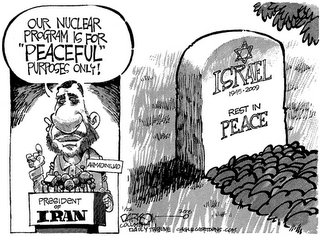
On another note, for an interesting take on the Holocaust Conference in Iran, read Rachel Talshir’s ‘And Thanks to Ahmadinejad.’ Didn’t really LIKE the ending, but all in all, a solid editorial.
Olmert has yet again disappointed. Instead of acting like the leader of an independent nation, his comments make it seem as if America dictates all that we do. Olmert should have said something along the lines of: ‘If Assad is willing to stop instigating terrorism, I would be willing to discuss a potential treaty with Syria.” Don’t get me wrong. I’m not supporting peace talks with Syria (not yet at least), especially not when Mossad chief Meir Dagan recently said that Syria is “’more prepared than ever before’ to take military action against Israel,” but we must at least try to see if Assad is being serious. We shouldn’t be guilty of, as Abban Eban put it with regards to our neighbors, missing an opportunity to miss an opportunity for peace. Let’s put the ball back in Assad’s court, let’s see if he’s serious. If he’s doing it because of international pressure or because of some master plan, he’ll be found out rather quickly I assume. If he’s being serious, Israel should immediately ask for Eli Cohen’s bones as a showing of good will and start discussing a way of making our North Western border peaceful. Let’s call Assad on his proposal – bluff or not, we have nothing to lose.
On another note, for an interesting take on the Holocaust Conference in Iran, read Rachel Talshir’s ‘And Thanks to Ahmadinejad.’ Didn’t really LIKE the ending, but all in all, a solid editorial.
Have a Good One!
Chag Chaunkah (or however you spell it!) Sameach to all of you ...
Here are Adam Sandler's famous Chanukah Songs:
Part 1:
Part 2:
All the links to the song are no longer working. Apologies!
Part 3:
Here are Adam Sandler's famous Chanukah Songs:
Part 1:
Part 2:
All the links to the song are no longer working. Apologies!
Part 3:
Sunday, December 17, 2006
Satmars ... Thank You
from Haaretz.com:
Despite their anti-Zionist stance, at least the Satmars have stood up and taken the right stance on Neturei Karta's sickening display of unity with the Jewish nation's enemies. As I said in my earlier blog about the subject, I was never upset about the anti-Zionist stance of the Neturei Karta. It did however infuriate me that yet again, their words became actions that could potentially endanger Jewish lives, and that crosses a line that can never be crossed. At least one positive came from this conference: the low, sick move by Neturei Karta united the Jewish people ...
Satmars: Jews at Iran Holocaust conference 'reckless outcasts'
By Shlomo Shamir , Haaretz Correspondent, and The Associated Press
NEW YORK - A half-dozen Neturei Karta followers who attended a Holocaust denial conference in Iran have come under intense criticism over the visit, with one of the world's largest Hasidic groups denouncing them as "reckless outcasts."
The Jews who went to Iran "trampled on the memory of their ancestors and people. They embraced the disciplines and followers of their murderers," said a statement from the Satmar leaders of Congregation Yetev Lev in Brooklyn.
The Jews who attended the conference are often confused with the Satmars, who also are anti-Zionist but acknowledge that 6 million Jews died in the Holocaust. Aside from their shared anti-Zionism, Neturei Karta followers and the Satmars both wear long, dark coats and wide-brimmed hats, and have beards and sidelocks.
The Satmars say there is no connection between them and Neturei Karta, a group that sent six delegates to the conference under the banner "Jews United Against Zionism."
They were led by a rabbi from the New York area, Yisroel Dovid Weiss. He said that while his group does not entirely deny the killing of Jews in World War II, the figures for how many people who died in the Holocaust are exaggerated. He said that "Zionists are using the Holocaust to brazenly and offensively oppress a people."
The Satmars from Congregation Yetev Lev responded, in their statement, that "the unavenged blood of the millions of Jewish victims cries out in pain and abhorrence, to these reckless outcasts, 'How can you sink so low?'"
The position of the Jewish delegates, the Satmars said, "is contrary to the teachings of our venerated Grand Rabbi Joel Teitelbaum, the founder and leader of the Satmar movement."
The Satmars, who claim about 100,000 followers worldwide, were founded by the Hungarian-born Teitelbaum, who died in New York in 1979. He was succeeded by his nephew, Moses Teitelbaum, who died last April.
Teitelbaum laid out the anti-Zionist doctrine that forbids Jews from creating a Jewish state until the Messiah comes and leads them to the promised land.
Hamodia, an English-language Orthodox Jewish daily in New York that is not affiliated with either the Satmars or Neturei Karta, published an editorial this week that said: "While we are speaking of insanity, it is impossible to report about this so-called conference without making mention of the handful of deranged men in Jewish garb" who attended. "These few individuals - who represent no one except themselves - are playing into the hands of our nation's archenemies."
Estimates of Neturei Karta followers range from several hundred to thousands, with dozens living in Monsey, New York, a community about 25 miles north of New York where some attend a house of worship called Yeshiva Beis Yahud.
There was no telephone listing for the house of worship. Calls to Moshe Beck, another Neturei Karta leader, rang busy for hours on Friday afternoon.
Another community of Satmars, based in the village of Kiryas Joel, about 50 miles northwest of New York, has also condemned Neturei Karta members for attending the conference.
Despite their anti-Zionist stance, at least the Satmars have stood up and taken the right stance on Neturei Karta's sickening display of unity with the Jewish nation's enemies. As I said in my earlier blog about the subject, I was never upset about the anti-Zionist stance of the Neturei Karta. It did however infuriate me that yet again, their words became actions that could potentially endanger Jewish lives, and that crosses a line that can never be crossed. At least one positive came from this conference: the low, sick move by Neturei Karta united the Jewish people ...
Saturday, December 16, 2006
Stevie G's Top 10 Goals
Can words define the most influential midfielder in England and the world? Here are his top 10 goals ... Take a bow Stevie G!
Only in Israel ...
Last night, I prayed the Shabbat services at the kotel, which is also known as the Western Wall or the Wailing Wall. I haven't prayed there in a long time, and as we were eating at a Rabbi's place nearby, I decided to daven there. I always enjoy praying there. It's a very spiritual & moving experience to open up your heart and your soul near the largest remaining artifact of the Second Temple. However, last night was even more special.
Near the wall itself, a large group of about 60 people were dancing and singing Shabbat Songs and religious Zionist songs. Now I know what you're saying, "What's the big deal?" Well, picture IDF soldiers with their berets on their heads, Haredim (ultra orthodox Jews), Settler youths and what seemed to be an Ethiopian group all dancing together. Despite their obvious differences in religious observance, traditions, dress and look, they all joyfully danced together and welcomed in the Shabbat. I've never seen something like that at the kotel, and to say that I was moved would be quite an understatement. What a kibbuz galuyout (In gathering of the Exiles) to witness. Things like that always give me hope that one day this nation will finally be united ...
Near the wall itself, a large group of about 60 people were dancing and singing Shabbat Songs and religious Zionist songs. Now I know what you're saying, "What's the big deal?" Well, picture IDF soldiers with their berets on their heads, Haredim (ultra orthodox Jews), Settler youths and what seemed to be an Ethiopian group all dancing together. Despite their obvious differences in religious observance, traditions, dress and look, they all joyfully danced together and welcomed in the Shabbat. I've never seen something like that at the kotel, and to say that I was moved would be quite an understatement. What a kibbuz galuyout (In gathering of the Exiles) to witness. Things like that always give me hope that one day this nation will finally be united ...
Friday, December 15, 2006
144 Hrs in 45 minutes
Those 144 Hours in June 1967 forever changed the landscape of the Middle East. Here's a short documentary about the 6 Day War, one of history's most stunning wars ... Also includes a short segment about Elie Cohen, Israel's most famous spy.
Thursday, December 14, 2006
Marking 30 years
A video conference marking 30 years since Operation Thunderbolt (The Raid at Entebbe) by talking with some of the event's participants ... If you don't understand Hebrew or the little French spoken, I do apologize!
Wednesday, December 13, 2006
The Enemy Within
In this past week’s parasha (Va’Yishlach), Yaakov prepares to meet Esau, his twin brother, for the first time since fleeing Cana’an due to the danger Esau posed to him. As he agonizes over the first meeting with his brother in 21 years, Yaakov continually refers to him as ‘Esau, my brother,’ (Genesis 32:18). Why would Yaakov refer to him as Esau and also as his brother? Those around him must have already known that Esau was his brother; couldn’t he just easily have said ‘Esau’ or ‘my brother’? Why both titles? Rabbi Abraham Twerski comments that Yaakov said this because he saw two potential threats: Esau, the man who swore to kill him and my brother, the man whose way of life could turn Yaakov away from the path he wanted to lead. He was wary of both threats and stressed it to those around him. Seeing the enemy, even if he's my brother, is an important part of survival, and this has been rather evident this week during the International Conference questioning the Holocaust in Iran.

On yet another stage where Mahmoud Ahmadinejad declared that the “Zionist regime [will] soon be wiped out,” the people who stole the spotlight were 6 ‘Jews'. Yup, you read that right, 6 ‘Jews’. In a conference where European and American writers gathered to argue the validity of the Holocaust, 6 members of the ultra-orthodox anti-Zionist Neturei Karta stood out. Dressed in the typical ultra-orthodox garb, they refuse to exactly say what they were doing at the conference but nonetheless, managed to slip in their usual, hate filled, anti-Zionist rhetoric: “It is the work of Satan that Zionists are able to convince the world that they represent Jews and Judaism and everybody who speaks against it is anti-Semitic.” How on earth can Jews attend a conference that portrays the Holocaust as a Jewish/Zionist lie? Despite the presence of famous holocaust revisionists and anti-semites, like David Duke (a former Ku Klux Klan leader) or Michele Renouf (a supporter of "Holocaust skeptics”), the conference's credibility was seemingly legitimized by the 6 ‘Jews’. With their photographs “given pride of place in the Arab media.”, these ‘Jews’ are what really allowed this conference to be a ‘success.’ Still hard to believe that they’re standing with people who want to destroy the Jewish presence in Israel – where do they honestly think us ‘fake’ Jews will be going? Absolute idiots.
 I couldn’t care less about Neturei Karta's views about Israel; It’s their actions that I find disappointing and extremely dangerous. Posing with Palestinian terrorists, the Hitler wannabe in Iran and holocaust deniers misrepresents the opinion of the dominant majority of the Jews in the world today. Their actions are dangerous not only because they give the Arabs extra fuel to hate Israel and justify any attempts to attack us, but because they also mislead an already misinformed world about the Jewish stance with regards to Israel & the Holocaust. I guess that’s what ‘Torah abiding Jews’ should be doing, increasing the danger to their ‘brothers’! Their utter hypocrisy is sickening (and rather infuriating to read about). Twerski’s comments about Yaakov’s awareness fit in perfectly here – our enemies are not only the 'taken for granted' ones, they are also the ones who claim to be a part of the Jewish nation and to know what’s best for us.
Three last comments about the conference:
1) It is important that there is worldwide condemnation against the conference. Perhaps now the world can also realize why stopping Iran from becoming a nuclear power is so essential to world stability and Israel’s existence … Words are great and all:
“I think it is such a symbol of sectarianism and hatred toward people of another religion. I find it just unbelievable, really”
Tony Blair
“We absolutely reject this. Germany will never accept this and will act against it with all the means that we have”
Chancellor Angela Merkel
“Conference showed a resurgence of revisionist theories which are quite simply not acceptable.”
French Foreign Minister Philippe Douste-Blazy
“I want to state my firm condemnation of any attempt to deny, trivialize or minimize the Shoah. Anti-Semitism has no place in Europe; nor should it in any other part of the world.”
EU Justice and Home Affairs Commissioner Franco Frattini
But actions would be far more meaningful
2) I think it’s also important to mention the few Arabs who actually spoke out against this conference. Several Arab MKs told the Knesset of their unhappiness with the conference taking place and that they were ashamed of their fellow Arabs for taking part in the conference. Nazir Majali, the Israel affairs commentator for Al-sharq Al-awsat, a daily published in Lebanon, rightly told Haaretz that Iran did a dangerous thing by “using the built-in hatred for Israel ... in order to deny the Holocaust. As an Arab and a Muslim, I am ashamed."
3) The conference actually marks a rarity as I find myself agreeing with Yoseph ‘Tommy’ Lapid, the former leader of the anti-religious Shinui Party. I’m sure those who know me well are surprised by this as I abhor Lapid’s racist and elitist stance on many issues. However, when Lapid called the Neturei Karta buffoons, how can I really disagree?

On yet another stage where Mahmoud Ahmadinejad declared that the “Zionist regime [will] soon be wiped out,” the people who stole the spotlight were 6 ‘Jews'. Yup, you read that right, 6 ‘Jews’. In a conference where European and American writers gathered to argue the validity of the Holocaust, 6 members of the ultra-orthodox anti-Zionist Neturei Karta stood out. Dressed in the typical ultra-orthodox garb, they refuse to exactly say what they were doing at the conference but nonetheless, managed to slip in their usual, hate filled, anti-Zionist rhetoric: “It is the work of Satan that Zionists are able to convince the world that they represent Jews and Judaism and everybody who speaks against it is anti-Semitic.” How on earth can Jews attend a conference that portrays the Holocaust as a Jewish/Zionist lie? Despite the presence of famous holocaust revisionists and anti-semites, like David Duke (a former Ku Klux Klan leader) or Michele Renouf (a supporter of "Holocaust skeptics”), the conference's credibility was seemingly legitimized by the 6 ‘Jews’. With their photographs “given pride of place in the Arab media.”, these ‘Jews’ are what really allowed this conference to be a ‘success.’ Still hard to believe that they’re standing with people who want to destroy the Jewish presence in Israel – where do they honestly think us ‘fake’ Jews will be going? Absolute idiots.
 I couldn’t care less about Neturei Karta's views about Israel; It’s their actions that I find disappointing and extremely dangerous. Posing with Palestinian terrorists, the Hitler wannabe in Iran and holocaust deniers misrepresents the opinion of the dominant majority of the Jews in the world today. Their actions are dangerous not only because they give the Arabs extra fuel to hate Israel and justify any attempts to attack us, but because they also mislead an already misinformed world about the Jewish stance with regards to Israel & the Holocaust. I guess that’s what ‘Torah abiding Jews’ should be doing, increasing the danger to their ‘brothers’! Their utter hypocrisy is sickening (and rather infuriating to read about). Twerski’s comments about Yaakov’s awareness fit in perfectly here – our enemies are not only the 'taken for granted' ones, they are also the ones who claim to be a part of the Jewish nation and to know what’s best for us.
Three last comments about the conference:
1) It is important that there is worldwide condemnation against the conference. Perhaps now the world can also realize why stopping Iran from becoming a nuclear power is so essential to world stability and Israel’s existence … Words are great and all:
“I think it is such a symbol of sectarianism and hatred toward people of another religion. I find it just unbelievable, really”
Tony Blair
“We absolutely reject this. Germany will never accept this and will act against it with all the means that we have”
Chancellor Angela Merkel
“Conference showed a resurgence of revisionist theories which are quite simply not acceptable.”
French Foreign Minister Philippe Douste-Blazy
“I want to state my firm condemnation of any attempt to deny, trivialize or minimize the Shoah. Anti-Semitism has no place in Europe; nor should it in any other part of the world.”
EU Justice and Home Affairs Commissioner Franco Frattini
But actions would be far more meaningful
2) I think it’s also important to mention the few Arabs who actually spoke out against this conference. Several Arab MKs told the Knesset of their unhappiness with the conference taking place and that they were ashamed of their fellow Arabs for taking part in the conference. Nazir Majali, the Israel affairs commentator for Al-sharq Al-awsat, a daily published in Lebanon, rightly told Haaretz that Iran did a dangerous thing by “using the built-in hatred for Israel ... in order to deny the Holocaust. As an Arab and a Muslim, I am ashamed."
3) The conference actually marks a rarity as I find myself agreeing with Yoseph ‘Tommy’ Lapid, the former leader of the anti-religious Shinui Party. I’m sure those who know me well are surprised by this as I abhor Lapid’s racist and elitist stance on many issues. However, when Lapid called the Neturei Karta buffoons, how can I really disagree?
Monday, December 11, 2006
Pennies versus Positives
A wonderful article from the Jerusalem Post about Aliyah:
So ... What are YOU waiting for?
Aliya By Choice
Rabbi Stewart Weiss
Jewish Agency Chairman Ze'ev Bielski had it right - and wrong - when he urged the American Jewish community to come to Israel because "the penny will drop and they will realize they have no future in the United States as Jews."
Of course, he's right about the ravages of assimilation and intermarriage, which are decimating not only American Jewry, but the Jewish populations of virtually every Western community.
These "twin towers of tragedy" have been perpetrating a "silent Holocaust" for at least half a century, inexorably grinding down the Jewish presence in the Diaspora. The numbers don't lie, and they indisputably show that Jewish populations outside of Israel are stagnating at best, and on the verge of vanishing at worst.
America is a classic case in point; its Jewish population has been stuck at 5.5 million to 6 million for more than half a century. The influx of thousands of Russian Jews to the shores of the goldene medina, the best efforts of anti-assimilationists to stem the tide and the spirited struggle to woo non-Jewish partners to the fold has not significantly altered the equation.
Meanwhile, hundreds of smaller, outlying Jewish communities have vanished, their once-proud synagogues turned into churches, mosques or medical clinics, while many larger Jewish enclaves have circled the wagons and use every trick in the book to keep their numbers from falling further.
BUT MY fellow Ra'ananite Ze'evik was a bit off the mark when he suggested that American Jewry could - or should - be frightened into making aliya because of the specter of the vanishing Jew.
That is a strategy that did not work when Ezra the Scribe tried it in Babylon as the Second Temple was being built; it did not work in Germany as the Nazis gained power; and it will not work in 21st-century America, either.
For starters, to whom will this approach appeal? Half of American Jewry has already experienced intermarriage in their nuclear family, or has become assimilated and ever more distant from Jewish commitment. They are past the point - socially, intellectually and conceptually - of considering coming here.
And the other half considers itself doing so well in the States - financially and religiously - that it cannot drag itself away from the good life. To move an American Jew sitting around his pool in LA , surrounded by his kollelnik sons-in-law and planning his biannual trip to Jerusalem's five-star hotels, an awful lot of pennies have to fall.
I PREFER taking a totally different tack. I think the aliya argument we make to our fellow Jews must be of a positive, not negative nature. World Jewry should be coming to Israel not because they have it so bad in their own countries, but because they could have it so good here.
From a religious perspective, Israel is at least the partial fulfillment of billions of prayers uttered over thousands of years. We beseeched God to return us to Zion, and so He did. He gave us another chance to build a Jewish homeland in the land of the prophets, on authentic Jewish soil, to control our own destiny and carve out a nation in the Jewish image. Do we not have a sacred obligation to try?
And we haven't done so badly, to be quite honest. We make our share of mistakes, to be sure. But we still have a thriving democracy, a dynamic economy and a courageous and devoted army whose morale remains sky-high despite the severity of the Lebanon war. Not to mention a 1,000 percent growth rate since the founding of the state.
For an observant Jew, Israel can be a paradise: The proliferation of learning opportunities for men and women, the kosher restaurants and hotels, the low cost of Jewish education and the ease with which we observe Jewish holidays at a fraction of the cost in the US are just some of the pluses.
Even for the non-observant, Israel is definitely where it's happening on the global Jewish scene. The arrow of Jewish history points here. Jewish destiny will be decided not in Joberg, but in Jerusalem; not in Teaneck but, yes, in Tel Aviv.
Israel is the engine that drives the Jewish nation, and anyone who wants in on the action needs to be here, not there. While stellar Jewish communities do indeed exist - even flourish - in the exile, they are, after all, still in the exile.
It's time our Israeli emissaries stopped accentuating the dismal state of Israel's economy, its dangerous neighbors, its precarious existence, blah, blah, blah. While this ploy may play upon Jewish emotions and enhance fund-raising, casting us in such a negative fashion does irreparable harm to Israel's image. Who would want to live in a place where the people are starving and terrorists lurk around every corner?
Instead, we ought to emphasize the miracle of Israel, its gritty determination to survive and its ability to defy all the odds and prosper.
Let's urge every Jew to seize the opportunity to be part of this amazing enterprise - not only financially, but also physically.
Over the years, we have characterized our role in the Jewish world as a place to run to when things turn bad out there. This has certainly been the motivating factor for immigration from North Africa, Russia, Ethiopia and, more recently, South America and France. But it doesn't have to stop there.
There must also be a concerted effort to encourage privileged Western Jewry to engage in aliya by choice - to make a free and focused decision to join the ingathering of the Diaspora because it makes sense.
Those who do opt for Israel will be making the right choice.
The writer, a rabbi, is director of the Jewish Outreach Center of Ra'anana.
So ... What are YOU waiting for?
Wednesday, December 06, 2006
On The Comeback Trail
Stellar Return by Veteran Not Enough For Colors
JERUSALEM, Dec 6 (Reuters) - Thousands cheered on the Colors team today as veteran playmaker Avram Piha made his return to the playing field. A severe ankle sprain had rendered the South African born player inactive for 2 months, and his absence was heavily felt. Despite pleas from his parents to pursue a physically less demanding career, Piha remained true to his heart and made his highly anticipated comeback tonight. Sporting a heavy ankle brace, Piha looked a few steps off the pace. This however did not stop the player from scoring a goal within a few minutes and settling into his favored midfield role rather comfortably.
The game was close for 60 minutes before the White team turned it up a gear and demolished an injury depleted Colors team. Despite the loss, Piha will be pleased with his goal and 3 assists tonight. He spoke briefly after the game: "It's nice to get back in the swing of things with a goal but I would have liked to win the game. This is just another step in my long journey back to fitness, and I want to thank my fans for sticking through me during this tough time." As he walked away, I could not stop but think that Wednesday night football will soon be seeing the best of the lad.
JERUSALEM, Dec 6 (Reuters) - Thousands cheered on the Colors team today as veteran playmaker Avram Piha made his return to the playing field. A severe ankle sprain had rendered the South African born player inactive for 2 months, and his absence was heavily felt. Despite pleas from his parents to pursue a physically less demanding career, Piha remained true to his heart and made his highly anticipated comeback tonight. Sporting a heavy ankle brace, Piha looked a few steps off the pace. This however did not stop the player from scoring a goal within a few minutes and settling into his favored midfield role rather comfortably.
The game was close for 60 minutes before the White team turned it up a gear and demolished an injury depleted Colors team. Despite the loss, Piha will be pleased with his goal and 3 assists tonight. He spoke briefly after the game: "It's nice to get back in the swing of things with a goal but I would have liked to win the game. This is just another step in my long journey back to fitness, and I want to thank my fans for sticking through me during this tough time." As he walked away, I could not stop but think that Wednesday night football will soon be seeing the best of the lad.
Olmert ... Wake Up
My first stint in miluim (reserve duty) was the week the Lebanon War started. It was during one of the breaks we had from the urban warfare drills that we gathered around one of the Army trucks to hear Ehud Olmert’s passionate speech to the Knesset. I have never been so moved by a speech before in my life. Olmert’s words were moving, powerful and struck a chord with all of the soldiers huddled around the one radio. We all wanted in, we all wanted to be a part of this war – to return our boys home. Some of the lines which still stick out to me today are:
Reading today’s Haaretz headlines, I realized yet again how we had been duped. Our ‘leader’, if you can call him that, had yet again proven his fine ability to talk but his failure to act accordingly to his words. Nope, I’m not talking about Olmert’s government's botched handling of the war, I’m talking about the fact that our leader is a slimy, cowardly politician who doesn’t back up his tough words and decrees with actions. Today, Olmert remarked:
What should we have done? What kind of statement is that? You ‘declared’ war on Hezbollah and Hamas. Did we stop after the first few days in 1973? Did we stop when our citizens were kidnapped before the rescue missions of Sabena and Entebbe ? Perhaps Olmert wasn’t really interested in a war, but in using the army and the situation as pawns in an attempt to validate himself as a leader. Let’s face it, a leader who was “a little disappointed by the continuation of Kassam rocket fire at the South by the Palestinians,” is obviously living in La La land. Wake up Ehud. You made promises about getting our boys back, about stopping rocket fire about ‘achieving goals’ and you’ve done nothing. You’ve failed – do the right thing, step down and allow the country to regain faith in her government.
If only Olmert was actually that man that July speech made him out to be ...
On the Palestinian front, we will conduct a relentless battle until terror ceases, Gilad Shalit is returned home safely and the shooting of Qassam missiles stops.
We will search every compound, target every terrorist who assists in attacking the citizens of Israel , and destroy every terrorist infrastructure, everywhere. We will persist until Hizballah and Hamas comply with those basic and decent things required of them by every civilized person. Israel will not agree to live in the shadow of missiles or rockets aimed at its residents.
It is a difficult battle! It may become even more difficult. It is a painful test, and we may have to bear more suffering. Such a battle is never easy. It is strewn with pain and suffering, sacrifice, and casualties.
We will do everything and make every effort to bring them home.
We will defend all of them, on behalf of all of them we will fight, and with all of them before our eyes – the civilians in the line of fire, the kidnapped fighters and their families – we will continue, without hesitating, without capitulating and without fear, until our goals are achieved.
Reading today’s Haaretz headlines, I realized yet again how we had been duped. Our ‘leader’, if you can call him that, had yet again proven his fine ability to talk but his failure to act accordingly to his words. Nope, I’m not talking about Olmert’s government's botched handling of the war, I’m talking about the fact that our leader is a slimy, cowardly politician who doesn’t back up his tough words and decrees with actions. Today, Olmert remarked:
What should we have done? Keep fighting and maybe create dozens more bereaved families to accelerate the return of two people, and I hope they are still alive, for whom it's a question of spending a little more or a little less time in captivity in the face of the possibility or certainty that many dozens more would be killed in the continued fighting?
What should we have done? What kind of statement is that? You ‘declared’ war on Hezbollah and Hamas. Did we stop after the first few days in 1973? Did we stop when our citizens were kidnapped before the rescue missions of Sabena and Entebbe ? Perhaps Olmert wasn’t really interested in a war, but in using the army and the situation as pawns in an attempt to validate himself as a leader. Let’s face it, a leader who was “a little disappointed by the continuation of Kassam rocket fire at the South by the Palestinians,” is obviously living in La La land. Wake up Ehud. You made promises about getting our boys back, about stopping rocket fire about ‘achieving goals’ and you’ve done nothing. You’ve failed – do the right thing, step down and allow the country to regain faith in her government.
If only Olmert was actually that man that July speech made him out to be ...
World ... Wake Up

David Ben Gurion once said that when Hitler threatened the Jews with extermination, the Jewish people did not believe him. But when Nasser made the same threats, they believed him (and we know what happened to him in '67). Can we please learn from history before it's too late?
Monday, December 04, 2006
Congrats to my Cousin!
Congratulations to my cousin, Simone Petousis, for being the top student in the Centre For Film and Media Studies, one of the schools of UCT (University of Cape Town). She received the 'Gold Medal' for her incredible few years, where she graduated with distinction in Media, Film Production and Script.
Mazel Tov and Good Luck!

Mazel Tov and Good Luck!

Wednesday, November 29, 2006
Glenn Beck presents Exposed
Thanks to Gilly for this link. Shocking stuff. Why is this stuff always ignored by the main stream media?
Sunday, November 26, 2006
Was it so long ago?
Truly hard to believe that it's already over 10 years since my Granny passed away after a long battle with cancer. It was an incredibly difficult time for all of my family. Nothing we could do would help this wonderful woman as she fought a losing battle against this killer disease ...
The first 3 'deaths' that truly affected me all somehow involved Gran. It was on her porch in 1991 that my mother told me that a close family friend in Istanbul had been shot down by Dev Sol militants. Andy Blake, a young father of 2, was gunned down in the prime of his life for no good reason. All I can remember was the shock, the difficulty of dealing with the fact that his two young children would be fatherless. To this day, I still find it extremely hard to look at the few pages in one of our family albums that has articles about his death. Only a year later, I would seek comfort from Gran as I dealt with the loss of my great grandmother, Nonna Lea. 'Alone' in England, I only felt comfortable breaking down with her - she would console me and assuage my fears that I hadn't taken advantage of having this woman in my life for over 12 years.
It was a few weeks after my Bar Mitzvah (early 1994) that my Granny discovered she had cancer. I struggle to remember what exactly I was told - but even as a 13 year old, I knew that her time was limited. It didn't stop me from praying every night though, begging for a miracle as I contemplated a life without a woman who's mere presence put such a smile on my face. Granny was a special special woman - full of life, always smiling and helping. We spent hours watching cricket (Still remember going crazy with her after Jonty's famous run out of Inzamam Al Haq during the 1992 Cricket world cup), tennis and any other sport that was on the Telly . She would always have her cabinets stocked with my favorite treats, be it fudge, meringues or peppermint crisps. It was her, along with Gramps, Nonnou & Nonna, that made Cape Town what it was to me. It just couldn't be taken away from me ...
No matter how difficult this was for me, I can't possibly even begin to contemplate what my mother went through. She was extremely close to Gran - talking to her daily it would seem. Gran was one of her 'pillars'. I know that Gran would always comfort my mom with regards to her worries about me and my 'problem child' ways - she had faith in me and I know that helped my mom (raising me must have been a right pain!). How can I even try to put into words what my mother was going through? The pain must have been unbearable - but credit to my wonderful mother; she managed to still raise 3 kids in another foreign environment while dealing with the situation ...
Leicester, 1996. My cousin's bar mitzvah. The effect of the chemo had left Gran exhausted but yet again, she showed her strength of character by making the 12 hour flight with Gramps to be with all of us for the occasion. The only thing I remember about those few precious weeks were when we said goodbye. My mom, dad, sister and I were crying. It was extremely difficult to say goodbye. And in this moment of sadness, my little 8 year old brother innocently asked, "Why are you all crying?" We all smiled despite our drenched eyes ... As we drove away, I knew I'd never see her again ...
October 14th, 1996. I awoke on Monday morning to the sound of my sister crying. That's all I had to hear to know she was gone. Seeing my mother that day was difficult. I don't remember her crying or anything, obviously just as strong as her now departed mother was. I don't think my mom has ever 'truly' been the same. While I can't see it as my mom has remained the same loving, happy, caring mother she's always been, losing such an integral part of your existence obviously changes you. I think in death, you can tell a lot about how a person lived. Nelson Mandela once said, "When we were born we cried and the people around us smiled. Live life so that when you die you are smiling and the people around you are crying." At least I know she's smiling from up above ...
(All the quotes are from Hootie & the Blowfish's Not Even the Trees)
Alone as I sit and watch the trees
Won't you tell me if I scream will they bend down and listen to me
And it makes me wonder if I know the words will you come
The first 3 'deaths' that truly affected me all somehow involved Gran. It was on her porch in 1991 that my mother told me that a close family friend in Istanbul had been shot down by Dev Sol militants. Andy Blake, a young father of 2, was gunned down in the prime of his life for no good reason. All I can remember was the shock, the difficulty of dealing with the fact that his two young children would be fatherless. To this day, I still find it extremely hard to look at the few pages in one of our family albums that has articles about his death. Only a year later, I would seek comfort from Gran as I dealt with the loss of my great grandmother, Nonna Lea. 'Alone' in England, I only felt comfortable breaking down with her - she would console me and assuage my fears that I hadn't taken advantage of having this woman in my life for over 12 years.
And I know I'll never see you again
It was a few weeks after my Bar Mitzvah (early 1994) that my Granny discovered she had cancer. I struggle to remember what exactly I was told - but even as a 13 year old, I knew that her time was limited. It didn't stop me from praying every night though, begging for a miracle as I contemplated a life without a woman who's mere presence put such a smile on my face. Granny was a special special woman - full of life, always smiling and helping. We spent hours watching cricket (Still remember going crazy with her after Jonty's famous run out of Inzamam Al Haq during the 1992 Cricket world cup), tennis and any other sport that was on the Telly . She would always have her cabinets stocked with my favorite treats, be it fudge, meringues or peppermint crisps. It was her, along with Gramps, Nonnou & Nonna, that made Cape Town what it was to me. It just couldn't be taken away from me ...
You see I'm tired of feeling this pain
No matter how difficult this was for me, I can't possibly even begin to contemplate what my mother went through. She was extremely close to Gran - talking to her daily it would seem. Gran was one of her 'pillars'. I know that Gran would always comfort my mom with regards to her worries about me and my 'problem child' ways - she had faith in me and I know that helped my mom (raising me must have been a right pain!). How can I even try to put into words what my mother was going through? The pain must have been unbearable - but credit to my wonderful mother; she managed to still raise 3 kids in another foreign environment while dealing with the situation ...
Does he realize he came down here
And he took you too soon
Leicester, 1996. My cousin's bar mitzvah. The effect of the chemo had left Gran exhausted but yet again, she showed her strength of character by making the 12 hour flight with Gramps to be with all of us for the occasion. The only thing I remember about those few precious weeks were when we said goodbye. My mom, dad, sister and I were crying. It was extremely difficult to say goodbye. And in this moment of sadness, my little 8 year old brother innocently asked, "Why are you all crying?" We all smiled despite our drenched eyes ... As we drove away, I knew I'd never see her again ...
I lay down with memories of you keep that keep me going on, going on
It makes me wonder as I sit and stare
Will I see your face again
October 14th, 1996. I awoke on Monday morning to the sound of my sister crying. That's all I had to hear to know she was gone. Seeing my mother that day was difficult. I don't remember her crying or anything, obviously just as strong as her now departed mother was. I don't think my mom has ever 'truly' been the same. While I can't see it as my mom has remained the same loving, happy, caring mother she's always been, losing such an integral part of your existence obviously changes you. I think in death, you can tell a lot about how a person lived. Nelson Mandela once said, "When we were born we cried and the people around us smiled. Live life so that when you die you are smiling and the people around you are crying." At least I know she's smiling from up above ...
(All the quotes are from Hootie & the Blowfish's Not Even the Trees)
The Palestinian ceasefire
held for exactly ... brace yourself ... 57 minutes.
Yup, within 57 minutes of a ceasefire 'brokered' by Israel and Hamas, a quassam rocket struck one of our towns. Shocking really ... I mean, who would have expected it?
Yup, within 57 minutes of a ceasefire 'brokered' by Israel and Hamas, a quassam rocket struck one of our towns. Shocking really ... I mean, who would have expected it?
Tuesday, November 21, 2006
Elders' logic?
It was the last thing I thought I'd hear out of this Indian girl's mouth. While having a chat in the office, she told me that the reason why Israel was allowed to bomb Lebanon was because of pressure exerted on the US by the Jews who control the US's financial institutions. Her 'simple' logic kinda startled me and I smiled and said, "You don't honestly believe that, do you?" To my dismay, she was being dead serious. Not sure if she was weened on any Elders of Zion literature or it's just the 'norm' nowadays to think this way, but it rather disappointed me.
While dining tonight with French Mike, a good friend, yesterday's event came up. His reaction was the polar opposite of mine; he commented, "I'm proud that relative to our numbers, we do have so much power." Come to think of it, although I do think our level of 'power' is vastly exaggerated, I'm also rather proud of how such a small percentage of the world's population has always managed to push itself so far ahead in so many fields.
And while we're on this topic of us 'in control' Jews, a joke:
Rabbi Altmann and his secretary were sitting in a coffeehouse in Berlin in 1935. "Herr Altmann," said his secretary, "I notice you're reading Der Stürmer! I can't understand why. A Nazi libel sheet! Are you some kind of masochist, or, God forbid, a self-hating Jew?"
"On the contrary, Frau Epstein. When I used to read the Jewish papers, all I learned about were pogroms, riots in Palestine, and assimilation in America. But now that I read Der Stürmer, I see so much more: that the Jews control all the banks, that we dominate in the arts, and that we're on the verge of taking over the entire world. You know – it makes me feel a whole lot better!"
While dining tonight with French Mike, a good friend, yesterday's event came up. His reaction was the polar opposite of mine; he commented, "I'm proud that relative to our numbers, we do have so much power." Come to think of it, although I do think our level of 'power' is vastly exaggerated, I'm also rather proud of how such a small percentage of the world's population has always managed to push itself so far ahead in so many fields.
And while we're on this topic of us 'in control' Jews, a joke:
Rabbi Altmann and his secretary were sitting in a coffeehouse in Berlin in 1935. "Herr Altmann," said his secretary, "I notice you're reading Der Stürmer! I can't understand why. A Nazi libel sheet! Are you some kind of masochist, or, God forbid, a self-hating Jew?"
"On the contrary, Frau Epstein. When I used to read the Jewish papers, all I learned about were pogroms, riots in Palestine, and assimilation in America. But now that I read Der Stürmer, I see so much more: that the Jews control all the banks, that we dominate in the arts, and that we're on the verge of taking over the entire world. You know – it makes me feel a whole lot better!"
Friday, November 17, 2006
Stopping the Rockets
The period leading up to the disengagement was heavily peppered with criticisms that warned of a mini terror state on Israel's border. Despite these warnings, with the most notable one coming from the Moshe 'Bugi' Yaalon (Chief of Staff at the time), Arik Sharon proceeded with the disengagement. It has now been over a year since the move and all the warnings are becoming harsh realities. Despite Egyptian forces 'patrolling' the Sinai/Gaza border, smuggling has drastically increased and Hamas and their ilk now have copious amounts of ammunition and weapons. This harsh reality will only be felt when we face a similar confrontation to the one we handled terribly in Lebanon a few months ago. To add to this already daunting future confrontation, Sderot and other towns close to the Gaza border have been pounded non-stop with quassam rockets - at higher rates than the previous 5 years. Our fellow brothers have become target practice to quassam rocket units (teams of 2 to 4 Arab terrorists) and our government has done very little besides the occasional incursion into Gaza to offset this danger. The ruling brass has led us to believe there is no real way to stop this unless we further capitulate to Arab terror and leave Yehuda and Shomron (commonly referred to as the West Bank).
There is a solution however. Instead of taking action that falls into their hand, Israel should attack this by playing to the IDF's strengths. Normally this would mean sending in our jets, however, our air force strikes have been proven ineffective as the F-16s are not scrambled quick enough to get to the quassam rocket launch sites. With the air force option being ruled out, DEBKAfile makes excellent points in advising that Israel uses commando units to ambush the quassam teams. DEBKAfile suggests that the IDF have commando units undercover at the suspected launch sites waiting to ambush these terrorists. Unlike any other viable options, terrorists would be eradicated before even finishing the set up of the quassam rocket launchers. This also needs to be used on the Gaza-Egypt border. If our 'allies', the Egyptians, refuse to combat the weapon smuggling, we need to assume the responsibility. This tactic can work - and collateral damage will be minimized, which is important to our count, our army and our code of values.
The IDF is blessed with some of the best commando units in the world. There are quite a few benefits for Israel if DEBKAfile's plan is implemented by our government and the IDF:
1) By allowing them to be constantly in action, we'd allow our commando units to be sharp and ready for any other potential conflict.
2) After a few successful strikes on the Gaza-Israel border, quassam rocket launchers won't bother with the tactic anymore. The facts that they'd know the IDF is waiting for them on their territory and the damage they can do is nil (assuming they're intercepted before launching the quassams) would deter terrorists from continuing this tactic.
3) The pyschological effects from such a tactic would alter the mindset of both nations. The Palestinians would yet again realize that 'violence' will not get them results against a stronger, more resolute people. Hopefully that would force their population to weigh a 'change in approach' to their dealings with us, and would lead us to more quiet interactions in an attempt for peace. As for the Israelis, stopping the quassam rocket threat would change the 'scenery' quite a bit. The people of Sderot, Ashkelon and the 'border' towns would feel that they haven't been forgotten. The Israeli population would regain some confidence in our government and the army's morale would also bounce back after the difficulties in Lebanon.
I think this is the time to act. We are facing a very difficult few months now due to a new European iniative (which doesn't require Hamas to recognize the Jewish State), a 'U-turn' Tony Blair (can he be trusted when he says Syria and Iran could play a “constructive role” in the Middle East?), and the return of James Baker to the region (Famous for his 'F**k the Jews' statement, and a member of the the first Bush government that forced Israel into Oslo). Just think, I haven't even mentioned our dear friends in Iran and their continual talk about wiping out Israel. As always, Israel needs to make a stand and show the world 'how it's done'. Talking to supporters of Radical Islamic terror tactics is as idiotic as was the appeasement tactic employed by Neville Chamberlain and Edouard Daladier in 1938 with Adolf Hitler. If only the world could wake up:
There is a solution however. Instead of taking action that falls into their hand, Israel should attack this by playing to the IDF's strengths. Normally this would mean sending in our jets, however, our air force strikes have been proven ineffective as the F-16s are not scrambled quick enough to get to the quassam rocket launch sites. With the air force option being ruled out, DEBKAfile makes excellent points in advising that Israel uses commando units to ambush the quassam teams. DEBKAfile suggests that the IDF have commando units undercover at the suspected launch sites waiting to ambush these terrorists. Unlike any other viable options, terrorists would be eradicated before even finishing the set up of the quassam rocket launchers. This also needs to be used on the Gaza-Egypt border. If our 'allies', the Egyptians, refuse to combat the weapon smuggling, we need to assume the responsibility. This tactic can work - and collateral damage will be minimized, which is important to our count, our army and our code of values.
The IDF is blessed with some of the best commando units in the world. There are quite a few benefits for Israel if DEBKAfile's plan is implemented by our government and the IDF:
1) By allowing them to be constantly in action, we'd allow our commando units to be sharp and ready for any other potential conflict.
2) After a few successful strikes on the Gaza-Israel border, quassam rocket launchers won't bother with the tactic anymore. The facts that they'd know the IDF is waiting for them on their territory and the damage they can do is nil (assuming they're intercepted before launching the quassams) would deter terrorists from continuing this tactic.
3) The pyschological effects from such a tactic would alter the mindset of both nations. The Palestinians would yet again realize that 'violence' will not get them results against a stronger, more resolute people. Hopefully that would force their population to weigh a 'change in approach' to their dealings with us, and would lead us to more quiet interactions in an attempt for peace. As for the Israelis, stopping the quassam rocket threat would change the 'scenery' quite a bit. The people of Sderot, Ashkelon and the 'border' towns would feel that they haven't been forgotten. The Israeli population would regain some confidence in our government and the army's morale would also bounce back after the difficulties in Lebanon.
I think this is the time to act. We are facing a very difficult few months now due to a new European iniative (which doesn't require Hamas to recognize the Jewish State), a 'U-turn' Tony Blair (can he be trusted when he says Syria and Iran could play a “constructive role” in the Middle East?), and the return of James Baker to the region (Famous for his 'F**k the Jews' statement, and a member of the the first Bush government that forced Israel into Oslo). Just think, I haven't even mentioned our dear friends in Iran and their continual talk about wiping out Israel. As always, Israel needs to make a stand and show the world 'how it's done'. Talking to supporters of Radical Islamic terror tactics is as idiotic as was the appeasement tactic employed by Neville Chamberlain and Edouard Daladier in 1938 with Adolf Hitler. If only the world could wake up:
Addressing a Harvard University audience Saturday, Army Gen. John Abizaid compared the rise of militant ideologies such as the force driving al Qaeda to the rise of fascism in Europe in the 1920s and 1930s and said: “If we don’t have guts enough to confront this ideology today, we’ll go through World War Three tomorrow.
If not stopped, said the general, “extremists would gain an advantage to gain a safe haven, to develop weapons of mass destruction, to develop a national place from which to operate. And I think that the dangers associated with that are just too great to comprehend.”
Thursday, November 16, 2006
Odd but True ...
Thought I'd share the following article I found on Yahoo! News ...
May the Force be with you.
Pair Use The Force For Jedi Religion
Two self-styled Jedi Knights are stepping up an intergalactic campaign for formal recognition. Umada and Yunyun, also known as John Wilkinson and Charlotte Law, want the UN to acknowledge "The Force" is worthy of being called a religion. The couple claim to be part of the UK's fourth largest religious group, after 400,000 people recorded their faith as "Jedi" in the 2001 Census.
They say that as a religion, they deserve tolerance and respect. November the 16th is the annual International Day for Tolerance.
And as part of a global battle worthy of Luke Skywalker's efforts against the Empire, the band of self-styled Jedis want the UN to re-name the day as Interstellar Day of Tolerance.
More people claim their religion to be Jedi in England and Wales than those who follow Sikhism, Judaism and Buddhism. And the cause has global support.
There are also 70,000 Jedi knights in Australia, 53,000 in New Zealand, and 20,000 in Canada.
This is Umada and Yunyun's letter to the UN Association:
To whom it may concern,
For the last ten years the United Nations has marked today as the International Day of Tolerance.
While we support this important work, we feel the UN needs to move with the times.
In the 2001 UK census, 390,000 people identified themselves as Jedi Knights, making us the fourth largest religion in the country.
We have a proud heritage dating back 195,000 years to our first Jedi, the blue haired, blue eyed Kaja Sinis, who was born on Coruscant.
Like the United Nations, the Jedi Knights are peacekeepers, and we feel we have the basic right to express our religion through wearing our robes, and to be recognised by the national and international community.
We therefore call upon you to change the 16th November to the United Nations Interstellar Day of Tolerance, to reflect the religious make-up of our twenty-first century civilization.
Tolerance is about respecting difference where ever it lies, including other galaxies. Please don't exclude us from your important work.
May the Force be with you.
Tuesday, November 14, 2006
Culture Shock!
One of the things that I'm really having a fun time getting used to in England is the etiquette here when coming off the metro or the buses. The people waiting to board the bus/metro will queue near the door and wait for all the passengers to exit before actually boarding their ride. This is the complete opposite of Israel, where the 'rush is on' when the doors open on buses and trains. I thought that I'd prefer the 'jolly' good manners of the Brits - but I somehow find myself missing the aggressiveness of the Israelis. Perhaps I find that more 'human' or 'real' ...
I can just imagine my first conversation with an Israeli on the subway about this phenomenon:
Avram: Can you believe these people?
Israeli: friarim (suckers)
Until next time ...
I can just imagine my first conversation with an Israeli on the subway about this phenomenon:
Avram: Can you believe these people?
Israeli: friarim (suckers)
Until next time ...
Sunday, November 12, 2006
From Up Above
Landing at Heathrow on Thursday night was amazing to say the least. I was truly taken aback by the gorgeous view - disappointed me that for such a beautiful world, we still remain the only species who continually destroy it.
The reason for being in London is actually ... business! My new employers, IDT Europe, have sent me here for 2 weeks of training. The first three weeks on the job as a wholesale pricing analyst have been challenging and fun. I've actually started coming to work with a smile on my face, eager to learn and continue on the learning curve. Quite a change, needless to say. Training starts tomorrow ...
As for my first weekend in London since the turn of the millennium - I spent it in Golders Green with my sister (who lives in London) and my 'rents (who made the 6 hr trek from New York). It was really nice to catch up - and just a pity we couldn't have Eitan with us. Golders Green is quite a nice place, heavily influenced by the Jewish & Israeli world. I actually felt quite at 'home' with the food and atmosphere in the area.
That's about it for now - I'm off to get my stuff ready for my first day of school, I mean training. Should be fun -
The reason for being in London is actually ... business! My new employers, IDT Europe, have sent me here for 2 weeks of training. The first three weeks on the job as a wholesale pricing analyst have been challenging and fun. I've actually started coming to work with a smile on my face, eager to learn and continue on the learning curve. Quite a change, needless to say. Training starts tomorrow ...
As for my first weekend in London since the turn of the millennium - I spent it in Golders Green with my sister (who lives in London) and my 'rents (who made the 6 hr trek from New York). It was really nice to catch up - and just a pity we couldn't have Eitan with us. Golders Green is quite a nice place, heavily influenced by the Jewish & Israeli world. I actually felt quite at 'home' with the food and atmosphere in the area.
That's about it for now - I'm off to get my stuff ready for my first day of school, I mean training. Should be fun -
Wednesday, November 08, 2006
Kashtan's Statement
 The 'Golden Generation' of Israeli football bought a lot of optimism to Israelis in the late 1980s and early 1990s. With names like Haim Revivo, Eyal Berkovic, Avi Nimni, Tal Banin and Itzik Zohar, Israel finally had the 'star power' they needed to compete on the international level. All these players performed well domestically, and were equal to the task abroad (Revivo was part of Spain's Team of the Season in in 98/99, Banin played in Serie A & Berkovic was a mainstay for West Ham, Celtic and Pompey), however, they failed to make an impression on the international level. From the games I watched, it seemed that it was the players' attitudes, and not their abilities, that hampered the team's progress. The players' attitude seemed to be that Israel was 'lucky' to have them playing for her, and not visa versa. Not surprisingly, with the exclusion of Avi Nimni from Dror Kashtan's first squad for the Euro 2008 qualifying, the 'Golden Generation' left Israelis wondering yet again 'what if?'
And so, this brings us to today's national team. This team seems different - not because of the undoubted talent, but because of their attitude on and off the pitch. Compromised of the youngsters who grew up idolizing the 'Golden Generation', these boys are well on the way to shining brighter, both abroad and internationally. With an influx of players from the talented U21 team, the ever improving national team could very well be the first Israeli team to compete in an major tournament in 38 years.
 During last month's 1-1 tie with Russia, there was one surprising omission from the starting line up. Yaniv Katan, Maccabi Haifa's captain and a mainstay of the national team over the past few years, had pulled out due to an injury. Despite the 'injury', he managed to play against Hapoel Tel Aviv only a week later, showing no ill-effects whatsoever during his team's 2-0 loss. Dror Kashtan didn't make any statements regarding the incident until Sunday night when he announced the squad for the November clash with Croatia. Yaniv Katan had been dropped - and although he didn't refer to him directly, Kashtan still made it obvious why the striker would not be lining up next week against the Croats:
Players have to do everything to represent the country, the national team is above all. If we talk a little about Zionism, we live in a country that the representation and defense of her are a necessary value in all. The point is people are always being called up for the country. I have expectations of every player; when he is called up to the flag, he is required to appear. Players to have to be willing to sacrifice themselves for the team.
I like the statement Kashtan is making despite the fact Katan's average start to the season is reason enough for his exclusion from the squad. It should be the pinnacle of any Israeli player's career to be able to wear the blue and white uniform, to sing the national anthem and to play in front of 40,000 cheering Israelis. This loyalty and pride needs to be ingrained in every Israeli player (not to mention any regular citizen) - and if players don't feel that it's a necessity, then they can watch the game, like us fans do, from the comfort of their homes.
Sunday, November 05, 2006
Obsession
A 'short' 12 minute movie about the scary reality facing 'The West'. I don't think enough people understand how real this threat is to our very existence (and I'm not just talking about Israel here) ...
To learn more, check out Obsession - The Movie
To learn more, check out Obsession - The Movie
Friday, November 03, 2006
November 4th, 1995
 I can remember that day quite clearly. It was basically a normal weekend except for an event that transpired thousands of kilometers across the Atlantic Ocean. At around 2 o'clock, my mother answered the phone and after putting it down, announced, 'Yitzchak Rabin has been assassinated'. Needless to say, we were all in shock. I couldn't believe it. Turning on the TV that night shocked us even further - the man who 'pulled the trigger' was Yigal Amir, a 26 year old law student from Bar Ilan (After reading a few books, watching the 'Kempler' footage and observing the obvious contradictions in this case, I am rather convinced that Yigal Amir was not the only man involved in this - and is most likely not the man who fired the shots that actually killed Rabin.). I cannot really remember my feelings or thoughts during that day besides the shock - Although I didn't really know anything about the man and his role in the country's past, I think I felt a deep loss, a loss of a man who was important to me.
  Those feelings of loss & pain haven't changed, but I never thought that my feelings towards his 'memorial day' within Israel would change so drastically. I actually cannot stand the day anymore. This should be a day where we can remember a man who defended this country for decades and strove to lead it to peace. He was a leading figure in the Palmach & the IDF and his decisions as the Chief of Staff (during the 6 Day War) and the Prime Minister (presided over the Entebbe Decision) were critical to our country's safety and standing in the region. Despite the long list of military successes, Rabin also strove for peace as he pushed for dialogue with the Palestinians as early as the mid 1970s and then pushed (or was pushed by George Bush as he told ABC News & William Safire) the Oslo peace process and a peace deal with Jordan. However, despite the fact we should all be united in remembering a towering figure in our short history (one only surpassed by David Ben Gurion and Menachem Begin), the day has been completely hijacked for selfish, political & personal gains by the Israeli left. Finally, the left has a day where it's 'ok' to bash the Right and blame them for Rabin's death and a day where it's 'ok' to bash religious Jews as if we were all to blame. Sadly, this day has veered off the path and lost its supposed meaning. Instead of uniting us in mourning for a man who tried to do what he saw as best for his country, it further widens the obvious cracks between us. While I can never forgive Rabin for his statements regarding the suicide bombings of 1995 ('the price of peace'), I feel he wanted what was best for Israel. So, despite the day's often hateful and cruel rhetoric, I still take the time to pay my respects to a man who did so much for this country.
Below is a nice clip with pictures of Rabin's life, with the song Ha'Reut in the background:
The rather famous eyewitness report - "Rabin put his right leg in the car, and suddenly there were shots", "Rabin was not hit":
Sunday, October 22, 2006

Saturday, October 21, 2006
Are We That Sleepy?
In a recent Haaretz article, Professor Robert (Yisrael) Aumann, the Israeli-American scholar who won the Nobel Prize for economics last year, talked about the possibility that Israel might not be around within 50 years. A few of his quotes (and my take on them) can be found below ...
I would change Professor Aumann's sentence to "Too many Israelis don't understand why they are here." No, I'm not saying that all Israelis (by this, I mean those born in Israel) are like this, but it is definitely something that seems to infect too large of a segment within our population. What Aumann is saying here is that Israel, unlike other nations, has a different reason for existence. Israel was built on the ashes of 6,000,000 of our brethren, and has survived due to incredible heroism and sacrifice. Israel is the only homeland for the Jewish people. The failure to understand this, or the 'fatigue' he talks about, could eventually erode our ability to deal with the challenges we continually facing. So, the desire to be here, to continue our existence as a Jewish State, needs to be nurtured and strengthened so that it is as intense as it is amongst the religious Zionists, secular Zionists and the dominant majority of our new immigrants. This part of the battle to be here is, in my opinion, just as important as the actual fighting on the battlefield itself.
During the war with Hezbollah, the days at the office were terrible. Every day, people at the office would be on the edge of their seats. We were worried about our friends, the deaths of our fellow countrymen, the damage being caused to our brothers up in the North and our inability to deal a crushing blow to Hezbollah. Every death hurt us inside, as if it was our friend that had been killed. We have become incredibly sensitive to the deaths of our fellow Israelis. Not to sound incredibly cruel or insensitive but this must never hinder our ability to fight. We are on the verge of some very serious conflicts with Syria, Hamas, Iran and Hezbollah - if we cannot accept that many of us won't be coming home from these battles, then we will not be able to succeed in our mission to defend this country properly. It's a tough reality, but this is the reality we need to face and accept in order to continue here. As Gaylord Nelson said, “The ultimate test of a man's conscience may be his willingness to sacrifice something today for future generations whose words of thanks will not be heard.”
"Too many Jews don't understand why they are here. If we don't understand why we are here, and that we are not America or just a place in which to live, we will not survive. The desire to live like all the nations will sustain us maybe another 50 years, if we are still here. Fatigue, in the State of Israel's situation, will lead to death, as occurs with mountain climbing. If a mountain climber is caught on the side of a mountain and it starts to snow, if he falls asleep, he will die. He must remain alert."
I would change Professor Aumann's sentence to "Too many Israelis don't understand why they are here." No, I'm not saying that all Israelis (by this, I mean those born in Israel) are like this, but it is definitely something that seems to infect too large of a segment within our population. What Aumann is saying here is that Israel, unlike other nations, has a different reason for existence. Israel was built on the ashes of 6,000,000 of our brethren, and has survived due to incredible heroism and sacrifice. Israel is the only homeland for the Jewish people. The failure to understand this, or the 'fatigue' he talks about, could eventually erode our ability to deal with the challenges we continually facing. So, the desire to be here, to continue our existence as a Jewish State, needs to be nurtured and strengthened so that it is as intense as it is amongst the religious Zionists, secular Zionists and the dominant majority of our new immigrants. This part of the battle to be here is, in my opinion, just as important as the actual fighting on the battlefield itself.
"We are too sensitive to our losses, and also to the losses of the other side. In the Yom Kippur War, 3,000 soldiers were killed. It sounds terrible, but that's small change."
During the war with Hezbollah, the days at the office were terrible. Every day, people at the office would be on the edge of their seats. We were worried about our friends, the deaths of our fellow countrymen, the damage being caused to our brothers up in the North and our inability to deal a crushing blow to Hezbollah. Every death hurt us inside, as if it was our friend that had been killed. We have become incredibly sensitive to the deaths of our fellow Israelis. Not to sound incredibly cruel or insensitive but this must never hinder our ability to fight. We are on the verge of some very serious conflicts with Syria, Hamas, Iran and Hezbollah - if we cannot accept that many of us won't be coming home from these battles, then we will not be able to succeed in our mission to defend this country properly. It's a tough reality, but this is the reality we need to face and accept in order to continue here. As Gaylord Nelson said, “The ultimate test of a man's conscience may be his willingness to sacrifice something today for future generations whose words of thanks will not be heard.”
Wednesday, October 11, 2006
Dare to Realize!
Three days ago, my blog mentioned the remarkable 1-1 tie between the Israeli and French Under 21 teams. The result, which meant Israel only needed a 0-0 tie tonight to advance to the Championships in 2007, made tonight's return fixture the main attraction in Israel:
With 8,000 fans crammed into the Herzilya stadium, the Israelis defended like lions as the French went looking for a goal early on. Only a fantastic Tom Almadon save kept the scores level at half time. With the French pushing more and more men forward, Israel started carving out chance after chance. However, the French keeper managed to pull off save after save, denying Omer Peretz, Idan Srur, Toto Tammuz and Ben Sahr. However, a perfectly executed fast break by Israel on the left flank allowed Amir Taga, who had only been on the pitch for a few minutes, to score the game winner in the 93rd minute. Our boys had done it. This Israeli U21 team had managed to write their name in our country's footy history books. The result not only booked our place in next year's Under 21 European Championships (only 8 teams made the Final), but also set themselves up with a chance to represent Israel in the 2008 Olympic football tournament in Beijing. What a great night for Israeli football and Israel in general, something to make us proud, to put a large smile on our faces. Our little country will be on all the major sporting newtorks next year (for all the right reasons) competing against the best Under 21 talent Europe has to offer for a chance to be called 'Europe's Best' ... Congrats ...
The Starting 11:
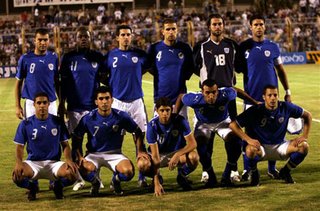
Amir Taga, the goal scoring hero, on top of Tom Almadon's shoulders:
Aviram Bruchian and Omer Peretz celebrate a historical night:
The celebrations continue between Omer Peretz and Lior Jean:

Ben Sahr, the 17 year old Chelsea striker, and Maor Melikson join in on the celebrations:

!!!אל אל ישראל
"An entire nation stands behind you in expectation; you have succeeded in uniting the country and bringing it pride. Together, the entire nation will be willing you on and we know that you are capable of completing the mission you have begun. Good luck."
Israel Football Association chairman, Itche Menahem
With 8,000 fans crammed into the Herzilya stadium, the Israelis defended like lions as the French went looking for a goal early on. Only a fantastic Tom Almadon save kept the scores level at half time. With the French pushing more and more men forward, Israel started carving out chance after chance. However, the French keeper managed to pull off save after save, denying Omer Peretz, Idan Srur, Toto Tammuz and Ben Sahr. However, a perfectly executed fast break by Israel on the left flank allowed Amir Taga, who had only been on the pitch for a few minutes, to score the game winner in the 93rd minute. Our boys had done it. This Israeli U21 team had managed to write their name in our country's footy history books. The result not only booked our place in next year's Under 21 European Championships (only 8 teams made the Final), but also set themselves up with a chance to represent Israel in the 2008 Olympic football tournament in Beijing. What a great night for Israeli football and Israel in general, something to make us proud, to put a large smile on our faces. Our little country will be on all the major sporting newtorks next year (for all the right reasons) competing against the best Under 21 talent Europe has to offer for a chance to be called 'Europe's Best' ... Congrats ...
The Starting 11:
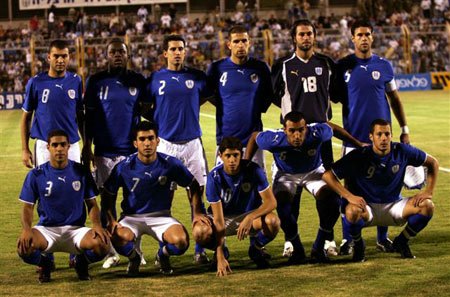
Amir Taga, the goal scoring hero, on top of Tom Almadon's shoulders:

Aviram Bruchian and Omer Peretz celebrate a historical night:
The celebrations continue between Omer Peretz and Lior Jean:

Ben Sahr, the 17 year old Chelsea striker, and Maor Melikson join in on the celebrations:

!!!אל אל ישראל
Monday, October 09, 2006
Testing the Time
I'm not sure what to make of it ... This was after all what was expected by the US, by China, by South Korea, by Japan, by the 'living in reality' world. North Korea made their intentions known, and they did what they wanted to do. The questions, which is what starts to scares me, now become - What does the world do? Does it do anything? What message will that send to Iran, who's going to be pulling off the same stunt in a year or two? Are we heading to that 'confrontation' that eluded the US and the USSR during the 'Cold War'?
Interesting times ahead ... I guess, everything for the better - so we'll just wait and see what happens ...
Interesting times ahead ... I guess, everything for the better - so we'll just wait and see what happens ...
Sunday, October 08, 2006
Dare to Dream
It was way back in 1970, some 36 years ago, when Israel's national football team last participated in a major international competition (1970's World Cup in Mexico). But on the back of 3 very solid results (a 1-0 win against Estonia, a 4-1 thrashing of Andorra and yesterday's 1-1 tie with Russia), Israeli fans are yet again starting to dream of a place amongst Europe's elite in the European Championships in 2008. Despite a very poor 1st half performance, the half time whistle blew with Israel only down 1-0. Although there was only a slight improvement in the 2nd half, two of Israel's up & coming youngsters managed to carve something out of nothing late in the game to steal a share of the points. On an error by a Russian defender, Toto Tammuz (a 19 year old born to Nigerian illegal immigrants) managed to get a vicious shot on goal which the Russian goalkeeper managed to deflect. Amit Ben Shushan, a 21 year old striker with bucket loads of potential, was there to collect the rebound and put in his 2nd goal in 4 competitive matches for the national team. Ben Shushan's goal not only lifted Israel to the top of the group (tied with England on 7 points), but it also continued Israel's remarkable 3 year unbeaten streak in competitive matches. To cap off a marvelous night for our football teams, our U21 team managed to tie the French U21 team 1-1 in Paris despite playing with only 10 men for 65 minutes. This team is oozing with talent, confidence, speed, technique and a belief that they belong. Israel's footballing future hasn't looked so bright in a long time - El El Yisrael!
Subscribe to:
Posts (Atom)

