"According to a celebrated study by the National Center on Addiction and Substance Abuse at Columbia University, published in a report called "The Importance of Family Dinners" [2005], the most successful children - the most well-adjusted, balanced, self-sufficient and self-confident children - are the children who have dinner with their parents at least five evenings per week."
Yisroel Roll in Shut Up and Stay Married*
* No need to worry, all is well with wife & I. Just reading a book recommended by Rabbi Twerski. Honest! :)
_
Sunday, July 31, 2011
Friday, July 29, 2011

Sunday, July 24, 2011
המלמד ידי לקרב ואצבעותי למלחמה
עבדיך נשאו את ראש אנשי המלחמה אשר בידנו - (מטות לא,מט)
נראה להסביר את דברי הכבוב, על פי מה שאמרו חז"ל בתלמוד ירושלמי (פאה א,א): "דורו של דוד כולם צדיקים, ועל ידי שהיו בהם דילטורין [מלשינים] - היו יוצאים למלחמה ונופלים. דורו של אחאב, היו עובדי עבודה זרה, ועל שלא היה בהם דילטורין - היו יוצאים ומנצחין". רואים מכאן כמה חמור חטא המלשינות ולשון הרע, עד שגורם שגם צדיקים ושלמים יפלו בקרב. חכמינו במסכת כתובות (ה,ב) נתנו לנו עצה איך להמלט מחטא זה, וכך כתבו שם: "מדוע האצבעות של אדם מחודדות כיתד? כדי שאם ישמע דבר שאינו הגון - יניח אצבעותיו באזניו". נמצא שלמעשה הכלי זין האמיתיים המביאים ניצחון במלחמה הם אותם ראשי אצבעות, שעוזרים לאדם להמנע מלשמוע דברי השמצה ומלשינות.
לאור הדברים הללו מתפרשים דברי הפסוק בצורה נפלאה. בני ישראל באים להסביר כיצד זכו במלחמה נגד מדין, וכך הם אומרים: "עבדיך נשאו את ראש אנשי המלחמה אשר בידינו", עבדיך עשו שימוש נכון בכלי מלחמתם, הם ראשי האצבעות שבידיהם - "ראש אנשי המלחמה אשר בידינו", ומשום כך זכינו ש"לא נפקד ממנו איש", כולם שבו בשלום מן המלחמה
This is taken from פניני הבן איש חי
_
Struggle
"A boy comes upon a butterfly emerging from its cocoon. He sees the nascent butterfly struggling. The cocoon flails back and forth as the butterfly struggles to set itself free. The boy has pity on the painful struggle of the butterfly and cuts open the cocoon. The butterfly is now free. Moments later, the boy sees the butterfly, and it is limping. He had hoped to watch it spread its orange and black Monarch wings and fly on its life's journey. Instead it is in pain. Its wings are glued shut. It cannot move. It soon dies.
In the end, the struggle of the butterfly was necessary for its wings to become healthy. The struggle was actually strengthening its wings and making them ready for the winds of life. Without enduring the struggle required to emerge from the cocoon, the butterfly could not gain the strength it needed to fly to freedom. Struggle and travail were essential for its survival."
Yisroel Roll in Shut Up and Stay Married*
* No need to worry, all is well with wife & I. Just reading a book recommended by Rabbi Twerski. Honest! :)
_
Sunday, July 17, 2011
Milulim
I spent last week deep in the Negev on Miluim.
* The July heat in the Negev is something else. When you sit down and can't stop sweating, it's hot!
* As usual, there were some fascinating discussions throughout the 5 days. I think Miluim gives the participants an amazing opportunity - meeting a wide variety of people from every walk of life which you'd normally not be spending any quality time with. Religious vs Secular, Fathers vs the Singles, Employed vs Self-Employed vs unemployed, Righties vs Lefties, Yeshiva Students vs 'Youth Movement' students, Sabras vs Olim - it's just a great melting pot, where everyone is linked by the green suit.
* I think this is the first business trip/miluim where Nissim realized I was gone. One morning, he asked Tals, "Where's Abba? Be'Milulim?, "(Where's Dad? In Miluim?). The additional 'l' cracks me up.
* I was really surprised to see how many people I talked to knew of Rav Chaim Amsalem. His message was very much applauded by those I talked to, and I'm very optimistic about where Am Shalem is heading.
* Every time I meet up with the lads, I'm impressed at the dedication and desire to be in Miluim. Yes, some come as it's a break from reality and a chance to meet 'good friends.' But most come due to a feeling of responsibility. It's reassuring - especially with all the flotillas, bad'law'illas, etc hounding our news streams 24-7. Israel will be ok ...
* I hope the next time I see these lads is next year ... but something tells me, they'll need us sooner unfortunately.
_
Wednesday, July 06, 2011
The last few weeks
After Shavout, the family & I flew out to New York for my sister's wedding. It was a lovely few weeks.
- Tova's wedding was just fantastic. It was a lovely day, and great to see the whole family together for such a happy occasion. Chupa was great, food was great, dancing was fun ... The most fun I've had at a wedding since my own wedding actually!
 Below is the video I made for the lovely couple - may they be blessed with many years of happiness and good health:
- I had the pleasure of being at Brian & Melissa's celebration of their April wedding. As Talya and I couldn't attend the wedding in Mexico, we were very happy that their scheduled celebration for friends and family in the New York area coincided with our visit. It was great to see Bri so happy. We've known each other for over 11 years now, and have shared many great times together. It's wonderful to see him and Melissa so happy together as hubbie and wife.
- On the way to shul on one Shabbat, someone shouted 'F*cking Jews' as we walked on a street parallel to Weaver Street. Still there ... alive and kicking I see.
- I went fishing with my dad and bro during the trip, and what a night it turned out to be! I caught 3 blues (the 2 I kept are below, while the 3rd I gave to a high school student from Harlem) and enjoyed the experience quite a bit.
 Back in Israel now ... reality ...
_
- Tova's wedding was just fantastic. It was a lovely day, and great to see the whole family together for such a happy occasion. Chupa was great, food was great, dancing was fun ... The most fun I've had at a wedding since my own wedding actually!
 Below is the video I made for the lovely couple - may they be blessed with many years of happiness and good health:
- At the wedding, Nissim met Emily Dagan, Tante Amelie's (z'l) great grandchild. The kids, named after their departed great grandparents (who were siblings), got along really well. It left Emily's grandmother saying, "I never fully understood the power of naming after relatives until I saw these two together."
-I really enjoyed watching Nissim and Keren interacting with their great grandparents. It gave me such pleasure.
-I really enjoyed watching Nissim and Keren interacting with their great grandparents. It gave me such pleasure.
- I had the pleasure of being at Brian & Melissa's celebration of their April wedding. As Talya and I couldn't attend the wedding in Mexico, we were very happy that their scheduled celebration for friends and family in the New York area coincided with our visit. It was great to see Bri so happy. We've known each other for over 11 years now, and have shared many great times together. It's wonderful to see him and Melissa so happy together as hubbie and wife.
- On the way to shul on one Shabbat, someone shouted 'F*cking Jews' as we walked on a street parallel to Weaver Street. Still there ... alive and kicking I see.
- I went fishing with my dad and bro during the trip, and what a night it turned out to be! I caught 3 blues (the 2 I kept are below, while the 3rd I gave to a high school student from Harlem) and enjoyed the experience quite a bit.
 Back in Israel now ... reality ...
_
Monday, July 04, 2011
Am Shalem Update
Background
MK Rabbi Haim Amsalem’s name has become synonymous with solving fundamental problems within the State of Israel. His battle against racism and discrimination (which received significant praise in the annual report of the State Comptroller), his writings allowing for leniencies within halacha to solve the conversion crisis, and his encouragement of Haredim to study general studies, join the work force, and serve in the IDF left him chastised and excommunicated by the Shas party. MK Rabbi Amsalem’s strong ideology and intense desire to address these and other critical issues plaguing the State of Israel from within, has led to his forming a new political movement called “Am Shalem.”
Goals
The Am Shalem movement, under the leadership of MK Rabbi Haim Amsalem, seeks to create a substantial public and political force which will succeed in bringing about a radical and significant change and improvement in the nature of the relations between the myriad components of Israeli society: Haredim - Religious Zionist – Traditional - Secular; Sephardim – Ashkenazim; Right wing – left wing; Jews – gentiles, and more.
Like all citizens of the State of Israel, Am Shalem hopes for the day when peace will come to our land. However, until that time comes and as we continue to work towards that dream, Am Shalem seeks to return the social issues which are vital to the State, to Israeli society, and to the existence of the Jewish people to the forefront of the national political agenda and to solve the most burning problems as outlined below.
Am Shalem is now beginning its difficult path to creating a better and more unified nation and country.
Livelihoods with Dignity
Hundreds of thousands of Jews in the State of Israel live below the poverty line or close to it. Entire populations, especially in the periphery, are not able to sustain themselves with dignity. In the Haredi population, work has become illegitimate, a development which has not only led this entire population to poverty but has also lowered the value of Torah and religion in the eyes of their fellow citizens. This runs counter to the way of Torah sages in the past who combined Torah with “parnassa.” The movement seeks to change the status quo in which an entire generation has been born into a life of poverty and whose sustenance is predicated on government subsidies by implementing the following actions:
1) The establishment of a network of quality, public Haredi schools in which students will be taught Torah and general studies on a high level leading towards full matriculation certificates. (Rabbi Amsalem is already hard at work trying to establish a private Haredi high school of this kind.) Am Shalem will also establish an academic institution of higher education in the “Yeshiva University” model in which all students will study toward academic degrees alongside their Torah studies and the option of studying for Rabbinic ordination. The above will be accompanied by a campaign to educate the Haredi public about not only the legitimacy of these institutions but also the special pride which its students and parent body should experience.
2) To facilitate the integration of Haredim into the workforce, Rabbi Amsalem has established a forum consisting of hi-tech entrepreneurs and managers. Am Shalem will continue to expand this forum which will both create and encourage local initiatives in the hi-tech industry in order to help integrate Haredim.
3) The key to earning a dignified livelihood is access to higher education. Am Shalem will work to pass legislation to encourage higher education among the youth of development towns and lower income neighborhoods. The law would dictate that the children of a person who lives in a development town or low income neighborhood for more than 15 years will be entitled to significant tuition subsidies towards university studies.
4) Canceling the V.A.T. tax for those who provide basic life necessities such as basic food items, medication and clothing
Equal sharing of national burdens
From the time of the establishment of the State of Israel until present times, we have needed a strong army to protect us, with God’s grace, from those who seek our destruction. Am Shalem sees the joint participation of all segments of society in bearing the burden of national defense as critical to our national success in Eretz Yisrael and will work to solve the problem in the following ways:
1) Requiring those who are exempt from IDF service by the State to serve in national or civil service for an equal period of time. Those who do so will be recognized as having served the State with the benefits that come from such recognition.
2) Work to increase and adjust existing programs for Haredi youth to serve in the army and dedicate resources to educating the Haredi population regarding the necessity of contributing its fair share to the nation through such service, a process which Rabbi Amsalem has already begun.
3) Establishing Yeshivot Hesder for Haredim to enable the combination of Torah studies and army service with sensitivity to the needs of the Haredi population. Rabbi Amsalem has already begun the process of establishing this option.
4) Ensuring that the State continues to view those select few who are completely and totally dedicated to Torah study as the elite of the nation and are supported comfortably by the nation. Their Torah study would be treated as their fulfillment of national service. This group will be chosen and monitored based on clear parameters.
Combating discrimination and racism
Am Shalem will combat discrimination of any kind with all means at its disposal and will confront and work to solve any revelation of racism. The movement has set a goal to establish legislation declaring the equality of human worth and equal opportunity for all citizens. Am Shalem will work to accomplish this in the following ways:
1) We will promote legislation to withhold funding from any institution suspected of discrimination. (Rabbi Amsalem earned the praise of the State Comptroller in his annual report as a person who “the Ministry of Education should learn from regarding how to deal with discrimination.”)
2) We will establish a hotline and an e-mail service to combat discrimination and racism. Attorneys will be available to provide free legal services to victims of discrimination. Rabbi Amsalem’s Knesset office is already engaged in dealing with complaints of these kinds and will continue to do so until this plague is removed from the State and our nation.
3) We will work towards enacting legislation to protect weaker populations from discrimination with a focus on improving the standing of the Ethiopian community.
A complete reshaping of the Chief Rabbinate
The Chief Rabbinate is controlled by extreme and anti-Zionist organizations. Am Shalem will work to establish a Rabbinate which exudes love of fellow Jews and the sharing of the beauty of Judaism to all Jews. Rabbinic and religious services must follow the path of Bet Hillel with a tolerant approach and a sensivity to the general public’s legitimate fears of religious coercion. Rabbi Amsalem has already demonstrated this approach in his Rabbinic positions for decades. This revolution will be carried out in the following ways:
1) The establishment of a state committee to define the role of the Chief Rabbi, city Rabbis, and neighborhood Rabbis.
2) The establishment of a committee to choose Rabbis similar to the committee to choose state judges. The committee will be comprised of both religious and secular people who will ensure that Rabbis will be chosen solely based on their qualifications and suitability for the position regardless of their political connections or their ethnic/family backgrounds. The committee will also arrange for local bodies of a similar makeup to choose the local Rabbis.
3) All Rabbis of cities and settlements will be subject to a set of uniform rules and laws like all other officials, with no distinctions made between different cities or the type of kippa worn by the Rabbi.
4) We will work to make a substantial change to the system regarding all religious services provided to all citizens. These changes will manifest themselves on three levels: a)Changing the halachic approach from the stringent one of today to the more lenient and tolerant spirit of Beit Hillel b)Changing the establishment’s approach towards religious services from one of distancing and hatefulness to a welcoming and loving approach. This will be reflected in the Rabbinate’s dealing with people in the areas of marriage, divorce, Mikveh, Kashrut, and burial. c)The Rabbinate will be evaluated measured based on the degree of satisfaction expressed by the recipients of its services. Grievnaces against individual Rabbis will be treated with the utmost seriousness
Solutions for the conversion crisis
Close to 400,000 immigrants who descend from Jews live in our midst today. They study in our schools, serve in the army, and take part in every fabric of Israeli life. Many of them want to join the Jewish people through conversion but have been prevented from doing so due to hostility from the Rabbinical establishment. This antagonism will lead to mass assimilation, civil marriages, and horrific polarization in the Jewish nation. Am Shalem intends to solve this problem in the following ways:
1) Implementing the halachic opinion of Rabbi Amsalem for the conversion of immigrants with Jewish roots based on his sefer, “Zera Yisrael” as the conversion policy of the State of Israel.
2) Establishing legislation to prevent any attempt to nullify conversions already performed. This concept goes against Jewish law and violates the civil and Jewish rights of all those who converted in Israel in accordance with the Chief Rabbinate. Rabbi Amsalem has already begun the process of establishing such a law.
3) As part of the revolution in the Chief Rabbinate, Am Shalem will establish a conversion framework which will provide halachic answers to those who come to convert and are from “zera yisrael.” Am Shalem will also build a database of people throughout the world who fit the category of “zera yisrael” to assist them with conversion questions and issues.
4) Establishing a national hotline and e-mail service to assist with conversion issues and the conversion process.
Am Shalem’s Potential
A poll carried out by a top polling company in Israel, “Maagar HaMochot” under the direction of Professor Yitzchak Katz revealed that if elections were held today, a movement led by MK Rabbi Haim Amsalem would win 6% of the votes and that up to 13% of voters say that voting for such a party is an option for them. This means that Am Shalem has the strong possibility of winning 5 seats in the next Knesset and a window of up to 15 seats!
_
Monday, June 06, 2011
Right of Return
A Palestinian cartoonist shows why the right of return of (the UNRWA defined) Palestinian refguees into Israel is so critical to Abu Mazen & co:
 _
_
Monday, May 23, 2011
Tzadikim's Graves
A student in the Kol Torah Yeshiva in Jerusalem approached his Rosh Yeshiva, Rav Shlomo Zalman Auerbach zt"l, and asked him the question, "May I leave my Torah studies in the yeshiva to go [for a short visit] and pray at the graves of tzadikim [righteous people] in the Galil?"
Rav Auerbach answered, "It is better to say in yeshiva, and study Torah."
The student replied, "Isn't there a time I could go to visit the graves of tzadikim? Doesn't Rav Auerbach go and pray by the graves of tzadikim?"
Rav Auerbach answered, "In order to pray at the graves of tzadikim, one doesn't have to travel up to the Galil. Whenever I feel the need to pray at the graves of tzadikim, I go to Mount Herzl [the national cemetery for fallen IDF soliders in Jerusalem] to the graves of the soliders who fell al Kiddush Hashem [for the sanctification of G-d]."
From Chief Rabbi Lau's book, אורו של עולם (page 380)
_
Saturday, May 21, 2011
Bibi should quote Rabin
Rabin's speech on October 5th, 1995:
_
The borders of the State of Israel, during the permanent solution, will be beyond the lines which existed before the Six Day War. We will not return to the 4 June 1967 lines.
First and foremost, united Jerusalem, which will include both Ma'ale Adumim and Givat Ze'ev -- as the capital of Israel, under Israeli sovereignty, while preserving the rights of the members of the other faiths, Christianity and Islam, to freedom of access and freedom of worship in their holy places, according to the customs of their faiths.
The security border of the State of Israel will be located in the Jordan Valley, in the broadest meaning of that term.
_
Wednesday, May 18, 2011
Remember the Altalena
An excellent piece by Jerold S. Auerbach on the Altalena:
Why should anyone remember a notorious pariah ship from Israel's war for independence? If for no other reason (and there are many), because it is likely to resurface from the depths of memory should Israeli-Palestinian negotiations, if and when they ever begin, focus on Jewish settlements._
The prospect of expelling thousands of Jews from the biblical homeland of the Jewish people will surely widen, perhaps violently and irreparably, the deep chasm that already separates secular from religious Israelis. Such a dangerously polarizing conflict has not roiled Israel for more than sixty years. When it did, in 1948, it brought the fledgling Jewish state to the precipice of civil war.
During its first weeks of independence, Israel confronted a military invasion from five Arab nations that were determined to annihilate it. The new state was already battered from months of Palestinian Arab violence within its porously unstable borders, climaxing with the fall of the Jewish Quarter in the Old City of Jerusalem. Israel was desperate for an infusion of weapons and fighters to prevent its annihilation.
Enter the Altalena, with more than nine hundred Holocaust survivors, war refugees and fighters, and tons of desperately needed military supplies. It sailed for Israel from Port-du-Bouc in southern France on June 11, the day when a month-long United Nations ceasefire began. Inspired, funded, and provisioned by loyalists of Menachem Begin's Irgun, it would join the roster of ill-fated ships that had exemplified the Zionist struggle to rescue Jews from annihilation and return them to their homeland.
If the Exodus - popularized in the romantic novel by Leon Uris that became an iconic Hollywood movie - is still revered as the valiant ship, the Altalena instantly became the reviled pariah ship. It arrived with the permission of the Israeli government - meaning Prime Minister David Ben-Gurion - at Kfar Vitkin, north of Netanya, on June 21. While weapons were unloaded on the beach, fighters were taken to a nearby immigrant camp to prepare for induction into the army.
But Ben-Gurion, fearing a right-wing insurrection, ordered the beach surrounded. Altalena passenger Dov Shilansky encountered an Israeli soldier in a command car. "I spoke to him in Hebrew," he recalled. "It was my first speech in Israel." Shilansky (who, forty years later, became Speaker of the Knesset) told him: "We've just arrived. We survived the Holocaust. We've come here to fight by your side. The homeland is in danger. We will join the army."
The soldier instructed him to go no farther. Shilansky replied: "We have no other way. I won't go back to Dachau. If we can't come to Israel, we'll go back to the sea." The soldier replied: "I don't care. Go back to the sea."
Later that afternoon, Begin - disregarding a ten-minute ultimatum to surrender all weapons - spoke to his assembled fighters. Suddenly, Israeli soldiers raked the beach with machine-gun bullets. Yaacov Meridor, Begin's second in command, ordered: "Don't shoot back." An Irgun fighter realized: "I couldn't shoot. My brother was on the other side."
Another newcomer was uncomprehending: "Instead of welcoming us they were killing and wounding many of our men whose only purpose was to help." Six Irgun men died in the fighting.
The Altalena sailed south, running aground off the Tel Aviv shore. After a battle erupted on the beach, Ben-Gurion ordered the Israel Defense Forces to destroy it. Some IDF soldiers refused to obey.
An officer protested: "I'm here to fight the enemy. I won't fight another Jew." He instructed the soldiers in his squad: "Do what your conscience tells you." (He became one of eight soldiers to be court-martialed for their disobedience that day.)
An Irgun fighter remembered: "If Begin had told us to fight we would have, but he did not want war between brothers and we accepted his leadership." Irgun fighters obeyed his command not to return fire.
Ben-Gurion was convinced - without a shred of supporting evidence (then or since) - that the Irgun was launching a putsch to overthrow his government. Late that afternoon, he ordered cannons to open fire on the ship. Hilary Dilesky, a volunteer from South Africa who had arrived in Israel only two months earlier, commanded the battery that was chosen to fire the first shot. Receiving his orders, he recalled, "I suddenly was struck with a heavy, deep feeling that I didn't want to shoot."
Dilesky approached his corps commander, telling him - in English, for he could not yet speak Hebrew: "I hadn't come to Israel to fight Jews." The commander yelled back that his job was to obey orders. It was, Dilesky recalled, "a fateful moment" when he realized that "following orders was the right thing to do." But "my heart was broken when we began firing," he confessed nearly fifty years later. "This has been a burden all my life," he recalled, "and still is."
With the Altalena ablaze from a direct hit, and the explosion of its munitions imminent, Irgun leaders (including Begin) and members of the crew jumped overboard, filling lifeboats and swimming ashore. An astonished American crew member observed that "continuous small arms fire from shore ... was directed at everyone in the water."
A 17-year-old Haganah soldier on the beach never forgot that "there were people on our side who waited until they saw heads above water, and then they fired at them."
A Palmach soldier recalled, "Firing on each other: it seemed illogical, unbelievable." He confessed: "I had many doubts, when I pointed the gun at the approaching boat filled with Jews." But he overcame them. "You tell yourself, you are guarding Israeli democracy. And with this belief, you shoot."
Another Palmach soldier was stunned by what he saw: "Before my eyes was waged a war between brothers. Jews are shooting Jews - in order to kill!"
Ben-Gurion enthusiastically blessed the "holy cannon" that destroyed the Altalena. He denied as false rumors the eyewitness reports from soldiers and journalists at the site of the Tel Aviv battle that Israeli soldiers on the beach had fired on desperate swimmers. That day, ten more Irgun men were killed. In the months that followed, eighteen Altalena fighters died for their country during the War of Independence.
* * * * *
The Altalena marked a tragic climax to fifteen years of bitter acrimony between Zionists on the left and right that had plagued the Yishuv during the years of British Mandatory rule. To some, it was a sorrowful reminder of the groundless hatred (sinat chinam) that was said to have plunged Jews into their devastating civil war in 1st century Jerusalem.
By now, however, most Israelis have long since repressed any memory of the Altalena, while few Jews outside of Israel have even heard of it.
But within the past decade, members of the Israeli left, taking Ben-Gurion's order to sink the Altalena as a model for the proper treatment of political opponents, proposed it as the solution to Yasir Arafat's internal conflict with Hamas.
The Arafat-Altalena analogy quickly caught on as a teachable moment. A Palestinian Authority official told the Jerusalem Post that in confronting Hamas and Islamic Jihad, "we have to act like Ben-Gurion in 1948."
Not long after proposals for an Arafat-style Altalena had receded, a far more volatile analogy erupted. Prime Minister Ariel Sharon's decision to remove 9,000 Jewish settlers from Gaza provoked wrenching and acrimonious debate over the future of Jewish settlements. The Israeli press, which enthusiastically supported the Gaza expulsion, vigorously defended Ben-Gurion's action in 1948 as a model to emulate.
To exercise its "sovereign duty," Yaron London wrote in Yediot Aharonot, Israel must once again use its "muscles" against those who violently opposed its decisions.
Moshe Negbi, legal commentator for the Israel Broadcasting Authority, complained (in Haaretz) that "Ben-Gurion's successors have demonstrated total limpness in imposing law and order on extremists.... It is this limpness that has brought down upon us the malignancy of the Jewish settlements" and their "fanatics."
On the political left, Ben-Gurion remained the inspirational leader who certainly could not be accused of "limpness."
The barrage of encouragement for an Altalena reprise roused 91-year-old Shmuel Katz, who had been a member of the Irgun high command at the time, and then a founder of the Herut party and Member of the Knesset.
These "pundits," Katz wrote in the Jerusalem Post, were "conjuring up the Altalena myth of a revolt that was never planned and never took place, a fiction woven by an unscrupulous politician at the cost of a score of innocent young lives and the loss of a valuable ship and an invaluable store of arms."
He claimed: "The memory of the Altalena is being manipulated for political purposes to facilitate the expulsion of the Jews from Gush Katif [Gaza]."
That same year, during the bitter Knesset debate over the expulsion of Orthodox settlers from the outpost of Yitzhar, Prime Minister Sharon was accused of wanting "a second Altalena" so that he, too, could "fire the 'holy cannon.' "
He was warned by settler groups: "You will not get a second Altalena from us. You will not get a civil war from us, because we - the citizens whom you wish to go to war against - will not fight against our brothers."
As national debate over settlements became increasingly acrimonious, some Israelis urged soldiers to refuse to obey orders for the forced evacuation of settlers. They cited the precedent of Palmach soldiers who had disobeyed orders to fire on the Altalena: "Refuse to obey the transfer order against your brothers, just as ... soldiers refused to shoot at their brothers in Ben-Gurion's day."
Recalling the tragic war between brothers in 1948, 82-year-old Yosef Nachmias, then a company commander on board the Altalena, recounted the refusal of his own brother, a Palmach fighter, to shoot at the ship because he knew that his sibling was on board. For Nachmias, killing brothers was not merely a metaphor.
During a military ceremony at the Western Wall in October 2009, two religious soldiers displayed a sign protesting settler expulsions. They served time in jail for their misbehavior; one of them was discharged from the army after refusing to express regret for his protest. Then, when Israeli security forces destroyed two Jewish homes in the settlement of Har Bracha, two religious soldiers displayed a banner from the roof of their military base opposing the expulsion of its residents. Sentenced to thirty days in military jail, they were demoted in rank and dismissed from command and combat duties.
Amid this simmering political and religious confrontation, Altalena parallels proliferated. Writing in Haaretz, Hebrew University political scientist Shlomo Avineri accused settlement defenders of attempting to undermine the "historic achievement of Zionism," the creation of "a single binding [national] authority" for the Jewish state.
Ben-Gurion's decision to attack the Altalena, he suggested, may have displayed "ruthless determination," but it assured to the Israel Defense Forces "a monopoly on the legitimate use of force." The pain and distress of settlement supporters was understandable, Avneri conceded, but "in the Jewish state only one legitimate body is authorized to enforce political decisions."
When six infantry soldiers refused to participate in demolitions in the settlement outpost of Negohot, Prime Minister Benjamin Netanyahu - sounding very much like Ben-Gurion in 1948 - asserted ominously: "If you support this refusal, it will bring about the collapse of the state." Israeli leaders, claimed Defense Minister Ehud Barak, were confronting "the same fateful decision that David Ben-Gurion faced in the first days of the state."
* * * * *
Should Israel and the Palestinian Authority ever reach agreement on the terms of peace between peoples who have engaged in bitter conflict over the same land for nearly a century, it will likely require the forcible removal of many tens of thousands of Jewish settlers from their homes.
Yet few Israelis who argue passionately for this outcome are likely to realize that soldiers who refuse to force settlers from their homes would be responding precisely as did the Haganah and Palmach soldiers in 1948 who refused to shoot their Irgun "brothers."
Such a confrontation would expose the core of Israel's still unresolved national identity struggle: Jewish state, secular state, democratic Jewish state? It has the ominous potential to reduce the Altalena to historical insignificance by comparison.
At a crucial moment in 1948, David Ben-Gurion faced the urgent necessity to protect the fledgling Jewish state and defend its sovereignty. But did he decide wisely when he issued the command to shoot Jews on the Altalena who wanted only to fight for the independence of Israel?
In his unrelenting determination to concentrate authority in his hands, did Ben-Gurion undermine, rather than strengthen, legitimacy in the new nation? Did he set a dangerous precedent for battles between brothers that has haunted Israel ever since and may yet explode into a far more volatile internecine conflagration than anything that happened in 1948?
The confrontation over the Altalena, and the tragic killing of Jews by Jews that accompanied it, remains a lingering, self-inflicted, wound from Israel's desperate fight for independence. It cuts to the very core of the enduring Israeli struggle over political legitimacy - then, now, and in the foreseeable future.
It also braids themes that are woven into the biblical narrative. In the beginning, after Creation went awry, Noah's ark - the first ship to be mentioned in a Jewish text - transported a righteous man and his family from impending disaster to safety.
There is also the recurrent tragedy of sibling rivalry, even fratricide. Cain and Abel. Isaac and Ishmael. Jacob and Esau. Joseph and his brothers. And in 1st century Jerusalem, Zealots ruthlessly slaughtered their fellow Jews in a civil war that shattered national sovereignty for two thousand years.
Whether secular and religious Jews can live together in Israel without the groundless hatred that retains the potential to destroy their nation from within remains an open question. If not, the Altalena may finally - but disastrously - be supplanted by a far more devastating Jewish tragedy.
Jerold S. Auerbach is the author of "Brothers at War: Israel and the Tragedy of the Altalena," from which this essay is adapted, to be published later this month by Quid Pro Books.
Tuesday, May 17, 2011
FC Jaffa lifts the Anglo Cup
FC Jaffa, the Anglo team I've been playing with for 2 years, won its first trophy this past Saturday night - The inaugural Anglo Cup. Bring on next year!

For photos: Click here
For a write up from one of our fans: Click here
Orange Army!
_
For photos: Click here
For a write up from one of our fans: Click here
Orange Army!
_
Tuesday, May 10, 2011
Splitting 63
I got a text message today from a good friend. He wanted to tell me that he and his wife were splitting up - a young family ruined. The relationship always seemed so strong, filled with love and caring. It hit me hard. It put a damper on the happiness of the approaching celebrations for Israel's 63rd Independence Day.
It's been on my mind for the past few hours.
This has further stressed to me the importance of always working on the relationship with my wife. A healthy relationship requires constant support, communication and love through the many ups and downs in the couple's journey through life. There's a reason the roots of happiness (שמח) and growth (צמח) are so similar - if you're not growing (together), you won't end up being happy (together).
Linking this episode to the joyous occasion of Israel's 63rd birthday is sadly too easy.
Too many of us take Israel for granted. We forget that our grandparents didn't have this privilege. We forget to appreciate walking on this land, to marvel at the return home of the Jewish nation from all corners of the earth and to take pride in speaking our once dormant language. We forget that if we don't strive to improve our relationship with our country and her citizens, we'll suffer a similar fate to the one we suffered under the Romans. We forget that if we don't strengthen our identity, be it here or abroad, all these miracles we've been a part of will all be for naught.
Israel has come a tremendously long way in a short period of time - but we need develop ourselves even more, and strive to better what needs improving within this country. This will ensure that the many sacrifices previous generations made will not be wasted and the future generations will have even more to appreciate than we did.
_
Sunday, May 08, 2011
Operation Cyanide
This past week, I watched the BBC documentary, "USS Liberty - Dead in the Water", on Documentary Heaven. The USS Liberty, a US Naval warship, was attacked and put out of commission by the Israeli Air Force and Navy during the Six Day War while in international waters. The documentary interviewed many surviving crew members (34 crew members died during the attack) and by the end, settled on the fact that the Israeli operation was intentional and was most likely, a part of Operation Cyanide, a Israeli-US plan to blame the Egyptians for the attack (I guess similar to the Lavon Affair) and get the US involved in the war. While there are a number of theories as to why the ship was attacked (They are fairly well detailed in this Wikipedia link), this was the first time I heard of this theory. Here are my thoughts:
1) I don't believe this attack was unintentional, which is the shared outlook of the US and Israel. I don't believe Jim Ennes, or other surviving crew members, would all repeat the same testimony essentially saying Israel knew the ship was American. The 'This is war' explanation may work for the the first strike, but why the repeated aerial and naval strikes? It doesn't really add up.
2) I don't believe Operation Cyanide makes sense on a few counts:
- Israel had already shown in '56 that their armed forces were capable of dealing with the Egyptian armed forces. While there was great uncertainty before '67, why would the US not have taken other 'steps' (i.e. increased military backing) to Israel before this drastic step?
- The idea that Israel, as per the documentary, had planned the operation for a couple of months before the war raises some question marks in my mind too. Was the US really that eager to get rid of Nasser? Were they that eager for a full out encounter with Nasser's main backers, the USSR? If they were 'anti-Nasser,' why was their approach in the Middle East often neutral (as it was during the Six Day War)?
- The interview with Rafi Eitan about the operation was also odd. Eitan acts as if he knows something, but then (obviously) refuses to reveal anything. Going by how 'big' this operation would have been, I don't understand how Eitan would have known about it. He wasn't, at least as far as I know, that senior that he'd been privy to those talks.
3) I do believe the attack was intentional. The world's most advanced spy ship was close enough to the Sinai coastline that there is no way they weren't spying - be it on the Israelis or the Egyptians. They were in a war zone and spying ... I still don't think however that there was a need for more assaults on the ship after the first one.
_
Friday, May 06, 2011
I know who I'm voting for ...
 Our Goal
To promote a unifying and tolerant approach that combines religious observance and tradition with open mindedness, while confronting contemporary challenges in the footsteps of our Sages and their teachings.
Our Objectives
· To promote the unity of the Jewish people through respecting the honor and rights of every individual.
· To strengthen Torah studies by guaranteeing decent and proper financial support for selected competent scholars, while encouraging participation in the workforce and higher education.
· To unify all sectors of Israeli society through equal sharing of the country’s burdens.
· To educate the youth regarding Jewish values and to instill them with a deep recognition and understanding of Jewish and Israeli heritage.
· To improve religious services in Israel while also separating them from the political realm.
· To combat discrimination and social injustice in all sectors of Israeli society without compromise.
· To disseminate the supportive stance of our Sages towards the Land and the State of Israel.
· To solve the conversion problems in the State of Israel and the controversy surrounding the IDF conversions of non-Jewish immigrants from Jewish descent according to the Halacha.
_
Wednesday, April 27, 2011
A Big Boy, A Scouser & Fathers
Keren's arrival in our lives has quite obviously changed a few things. The one thing that slipped my mind was brought to my attention by my sister, who visited Israel with her fiancee this past week. When I commented on what a big boy Nissim is, she wisely said, "He only seems big now because you're comparing him to Keren. Remember, he's still a little boy." My lil sis made an important point - I may subconsciously be looking at Nissim as a 'big boy,' but in fact he's still that same happy and curious 2.5 year old he was before Keren was born.
***
Before the start of 7th day of Chag (Passover), I ran to the nearby 24-7 supermarket to buy some ingredients so that Talya could make albóndigas (meat balls). While waiting on line, an old man looked at my Liverpool shirt and asked, "What's your connection to Liverpool?" "I've been a fan since I was a little boy," I answered, "And you?" "I'm from there," he answered proudly. Jokingly, I ensured that he wasn't from the 'blue half' of Merseyside before wishing him a Chag Sameach. Despite a reputation for the opposite, Jerusalem really is quite diverse ...
***
As there's not enough time to write about a mishna from each chapter of Pirkei Avot (which Sephardim & Mizrachim start reading this upcoming weekend) this year, I'll just link to the blogs I wrote during the cycles of 2008 and 2010:
Chapter 1: 2008, 2010
Chapter 2: 2008, 2010
Chapter 3: 2008, 2010
Chapter 4: 2008, 2010
Chapter 5: 2008, 2010
Chapter 6: 2008, 2010
_
***
Before the start of 7th day of Chag (Passover), I ran to the nearby 24-7 supermarket to buy some ingredients so that Talya could make albóndigas (meat balls). While waiting on line, an old man looked at my Liverpool shirt and asked, "What's your connection to Liverpool?" "I've been a fan since I was a little boy," I answered, "And you?" "I'm from there," he answered proudly. Jokingly, I ensured that he wasn't from the 'blue half' of Merseyside before wishing him a Chag Sameach. Despite a reputation for the opposite, Jerusalem really is quite diverse ...
***
As there's not enough time to write about a mishna from each chapter of Pirkei Avot (which Sephardim & Mizrachim start reading this upcoming weekend) this year, I'll just link to the blogs I wrote during the cycles of 2008 and 2010:
Chapter 1: 2008, 2010
Chapter 2: 2008, 2010
Chapter 3: 2008, 2010
Chapter 4: 2008, 2010
Chapter 5: 2008, 2010
Chapter 6: 2008, 2010
_
Thursday, April 21, 2011
Gaza's Humanitarian Crisis
Won't make much difference, but at least the truth does make noise sometimes:
In an interview published on the IDF's Spokesman's Office website, Mathilde Redmatn, deputy director of the Red Cross in the Gaza Strip, said that there "is no humanitarian crisis in Gaza," adding: "If you go to the supermarket, there are products. There are restaurants and a nice beach."_
Rather, according to Redmatn, the issue in Gaza was "mainly in maintenance of infrastructure and in access to goods, concrete for example."
Referring to Israel's blockade on the Strip, Redmatn said that while "Israel has the legitimate right to protect the civilian population, this right should be balanced with the right of 1.5 million people living in the Gaza Strip."
"Despite the easing of the closure and the partial lifting of export bans in the wake of the flotilla incident, continued restrictions on the movement of people and difficulties in importing building materials hampered sustainable economic recovery and dashed any hope of leading a normal and dignified life," the Red Cross official was quoted as saying.
"Our goal is not to negotiate peace, but to ensure the well-being of the civilian population," Redmatn told the IDF website.
"We understand and recognize Israel's right to security but it needs to maintain the balance between that and the right of Palestinians living in Gaza to [earn] a living and to [access] proper medical care. Of course this is also the responsibility of Hamas to its citizens and therefore we also have relations with them."
Redmatn also reiterated her condemnation of rockets fired from Gaza into Israel, saying that "rocket-fire from the Gaza Strip is against international law because it is directed at civilians," adding that the Red Cross conducts a "confidential or bilateral dialogue with Hamas on the matter. As time passes, the dialogue also develops."
Saturday, April 16, 2011
All in the Name, Part II
During my daughter's Zeved Ha'Bat today, the lil one finally got her name ... Keren* Sonia** Piha.
* Talya and I both really liked the name. The translation of Keren is 'ray of light,' which we felt symbolized the extra brightness she's added to our lives since her birth last week.
** We decided to honor my late Granny, Sonia Levitt, who passed away in 1996 after a long bout with cancer. She always radiated positive energy and came off as a happy, good person. She had an extremely positive effect on my life and I'm extremely honored to have our first daughter carry her name. She was definitely a 'ray of light' in the lives of those who had the privilege of knowing her.

Shavoah Tov & Happy Passover ... שבוע טוב וחג פסח שמח וכשר
_
Monday, April 11, 2011
Thoughts & Pics
Talya started having contractions on Tuesday. Despite growing intensity, they weren't close enough to warrant a return visit to the hospital after the first two visits. By Thursday night however, the contractions were strong enough to get us to the hospital. This time, unlike the previous two times, they took us in. This was it, we're going to have another child. We were excited.
***
The time in the hospital was surreal - to see Talya dealing with such pain was humbling. I know couples are in this 'together' and that the wife heavily relies on the verbal support of her husband, but let's be honest - this is the woman by herself. Tals was incredible - and to see her holding her child after so many hours of pain and struggle was a moment I'll always cherish.
***
When the doctor handed over the little princess, she immediately told us, "You best say Ha'Gomel tomorrow." I ignored it at first as a woman is supposed to say Ha'Gomel after every pregnancy. Then she showed me the umbilical cord and I understood. It was knotted - it was a miracle that this complication didn't cause any problems. Pregnancy is an amazing process, but one 'little' glitch and there's often times serious complications. Toda la'el that that one 'glitch' had no effect on our process.
***
Nissim's first interactions with his sister were precious. He was mesmerized by her at first.
 As we changed her, his amazement turned to concern as he asked her, "Mah kara?" ("What happened?").
 To try and calm her down, he tried helping his mother push the pacifier into his sister's mouth.
 He succeeded and the siblings are happy! So far at least! :)

No name yet. We're still working on it. I guess that will have to wait till the next blog ...
_
***
The time in the hospital was surreal - to see Talya dealing with such pain was humbling. I know couples are in this 'together' and that the wife heavily relies on the verbal support of her husband, but let's be honest - this is the woman by herself. Tals was incredible - and to see her holding her child after so many hours of pain and struggle was a moment I'll always cherish.
***
When the doctor handed over the little princess, she immediately told us, "You best say Ha'Gomel tomorrow." I ignored it at first as a woman is supposed to say Ha'Gomel after every pregnancy. Then she showed me the umbilical cord and I understood. It was knotted - it was a miracle that this complication didn't cause any problems. Pregnancy is an amazing process, but one 'little' glitch and there's often times serious complications. Toda la'el that that one 'glitch' had no effect on our process.
***
Nissim's first interactions with his sister were precious. He was mesmerized by her at first.
 As we changed her, his amazement turned to concern as he asked her, "Mah kara?" ("What happened?").
 To try and calm her down, he tried helping his mother push the pacifier into his sister's mouth.
 He succeeded and the siblings are happy! So far at least! :)

No name yet. We're still working on it. I guess that will have to wait till the next blog ...
_
Friday, April 08, 2011
The New Arrival, Part II
Talya and I are very happy to announce the arrival of our second child, a baby girl born this morning at 10:15am at Hadassah Ein Kerem. She weighed in at 3.2 kilos and kept her mom busy the past 48 hours!
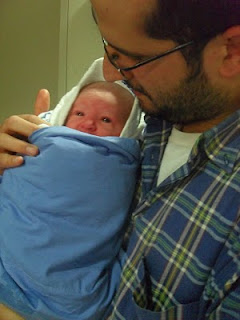

 The name, many thoughts (probably) and more pictures to follow ... stay tuned.
_


 The name, many thoughts (probably) and more pictures to follow ... stay tuned.
_
Subscribe to:
Posts (Atom)


