Hanukkah Sameach ... חנוכה שמח
The Recipe:
Making the Syrup (left) while Heating up the Oil (right):

Frying the Burmwelos:

The Finished Product:

B'Tselem has pulled it off again, duping the mainstream media into believing it has tallied civilian Palestinian casualties when it has done no such thing. The oft-cited organization bills itself as a human rights group devoted to rigorous documentation of Israeli conduct in the West Bank and Gaza aimed at educating the public and encouraging political action. Yet the so-called documentation continues to be marred by serious flaws that journalists routinely ignore while reporting the group's charges at face value.
B'Tselem, it should be noted, is heavily funded by European entities, including German, British, Irish, Dutch, Danish, Norwegian and Swiss groups, as well as the Ford Foundation and the New Israel Fund.
Among the most deceptive claims by the group are those embedded in its yearly statistical summary of Palestinian fatalities. B'Tselem reported in a Dec. 31, 2007 press release that in 2007 Israeli security forced killed 373 Palestinians and that “about 35 percent of those killed were civilians who were not taking part in the hostilities when killed.” These claims were reported without caveat in the New York Times, Voice of America, the Guardian, and the New York Jewish Week, among others.
Despite the press release's statement about the percentage of those killed who were civilians, B'Tselem's data do not actually break down Palestinian casualties according to civilians or combatants. In most but not all cases, the organization's detailed list of Palestinian casualties classifies each person as “Killed when participating in hostilities” or “Did not participate in hostilities when killed.” Clearly, those in the latter category are not necessarily civilians, as a terrorist could be killed while, for instance, not directly in the process of planting a bomb or shooting a soldier. Moreover, B'Tselem almost never includes any reference to terrorist affiliations of Palestinian casualties, making it impossible for readers to know who was genuinely a civilian and who was not.
The Peace Now organization and activists Hagit Ofran and Dror Atkis must pay residents of Judea and Samaria and issue a public apology, Jerusalem Magistrates Court judge Yechezkel Barclay ruled Thursday. The group was punished for a false report involving the town of Revava.
Peace Now, Ofran and Etkes were sued for damages caused by a report published two years ago. In the report, titled “A sin leads to another sin,” (Aveira goreret aveira in Hebrew), Peace Now argued that most Jewish towns in Judea and Samaria were built on land stolen from local Arabs. Among other things, the report said 71.15 percent of the land on which Revava was built was stolen from Arabs.
"The Fund for Redeeming the Land,” which legally owns 100 percent of the territory on which Revava is built, demanded that Peace Now correct its false report regarding Revava and issue an apology. The group refused to apologize, as did the authors of the report. The authors agreed to only partially correct the mistaken claim regarding Revava, changing the report to say 22 percent of the land was stolen, not 71 percent.
When Peace Now refused to apologize, the Fund sued the organization with the help of Attorney Doron Nir Tzvi. The group charged Peace Now and authors Ofran and Etkes with slander.
The court found the three defendants guilty. Besides ordering them to apologize, Justice Barclay ruled that they must pay the Fund for Redeeming the Land 20,000 shekels plus tax. The group's apology must be public, and must be published in both Maariv and Haaretz.
"The time has come to end the serial lies issued by various leftist groups,” Attorney Nir Tzvi said following the court's decision. “The public should doubt any report they write.” Nir Tzvi called on Jews living in Judea and Samaria to “stand up for their good name” when facing false accusations from groups like Peace Now.
 ... but at least they'll know there's a serious problem there ...
Yesterday the Likud chose a good line-up, which will rule Israel, and I congratulate it. I'm not a conditional Israeli, and not a conditional Likudnik, and I will continue to contribute to the state of Israel and to Israeli society to the best of my ability
In 1945 there were up to one million Jews living in the Middle East and North Africa outside the British Mandate of Palestine - many living in communities dating back more than three millennia. Today, there are several thousand. Who are these Jews? What precipitated their mass-exodus in the 20th century? Where did they go? And why don't we know their stories?


Stamped for Life
When Hitler invaded Poland in 1939, Polish Jewry was trapped between two beasts, the Nazis to the West and the Communists to the East. On one side was certain death, on the other was spiritual destruction. There was nowhere to turn. As darkness set upon the European continent, the sun began to dawn in a far away land, where no one ever would have expected -- Japan, the land of the rising sun.
Polish and Lithuanian Jews sought to escape across the barren Soviet wasteland to the Far East. Underneath the Nazis' very nose, thousands of Jews took refuge in Japan, amongst the Nazis' own allies. How did they make it through the iron curtain to safety? As many as 10,000 Jews owe their salvation to the actions of one man and his wife, who defied everything but their own morals to save lives.
Rebel with a Cause
Chiune Sugihara was born on January 1, 1900, in Yaotsu, a rural area in Japan, into a middle class samurai family. Although the samurai clans put great emphasis on honor and tradition, Chiune was a rebel for most of his life. Instead of following in his father's footsteps and becoming a doctor, he deliberately failed the medical school entrance examination and instead pursued a degree in English literature with a hope to someday travel abroad. The Japanese Foreign Ministry eventually recruited him to serve as Foreign Minister in Manchuria in 1918 where he met with great success. While in Manchuria, Chiune became fluent in Russian and German and ended up converting to Orthodox Christianity. Despite his success, Chiune quit his post in Manchuria in protest over Japanese mistreatment of Chinese locals. In 1935, he returned to Japan, where he married Yukiko Kikuchi and together they had four sons.
In 1939, he became a vice-consul of the Japanese Consulate in Kaunas, Lithuania. When Russia took over Lithuania in 1940, annexing it to the Soviet Union, thousands of Jewish refugees attempted to obtain exit visas to escape the iron grip of Communism; they knew full well that if they remained behind, they would either be forced to give up their Torah lifestyle or be shipped off to the dreaded Siberia. Furthermore, everyone knew that it was just a matter of time before Hitler broke his pact with Stalin and began his conquest of the Soviet Union. The refugees included several of the most prestigious yeshivas of Europe as well as many of the leading Rabbis of the time.
Leaving the Soviet grasp was not easy. The Soviets would only issue an exit visa to people possessing an entrance visa to a foreign country however it was almost impossible to find a foreign consulate who would grant such a visa. It was now Chiune Sugihara's moment to enter the stage.
Saving Lives Every Moment
Despite the refusal of the Japanese government in Tokyo to grant visas to anyone lacking the proper funds, Sugihara chose to defy official orders. From July 31 to August 28, 1940, Sugihara began to grant visas on his own initiative. During this time, he would spend 18 hours a day hand writing over 300 visas daily, more than one month's regular quota. He refused to take breaks to eat, knowing that every moment was a chance to save another life. At the end of each day, his wife recalled massaging his swollen hands.
He promised the crowds of refugees gathered outside the walls of the consulate that he would not abandon them. He would keep writing until every single person had a visa. "It is the kind of sentiments anyone would have when he actually sees refugees face to face, begging with tears in their eyes," he said. "He cannot just help but sympathize with them. Among the refugees were the elderly and women. They were so desperate that they went so far as to kiss my shoes, Yes, I actually witnessed such scenes with my own eyes." (Levine, Hillel. [1996]. In Search of Sugihara: The Elusive Japanese Diplomat Who Risked His Life to Rescue 10,000 Jews from the Holocaust, p259).
Sugihara continued to issue visas until he was forced to leave his post on September 4 when his consulate was dissolved due to the impending Nazi invasion. He continued to write visas while in transit, throwing them into the crowd of desperate refugees while he boarded his train. When the train began to depart from the station, he allegedly threw his visa stamp into the crowd, enabling the Jews to continue to write their own visas. If he was humanly capable of doing more he would have. He was forced to leave so many behind, and it broke his heart that he was unable to save more.
From Obscurity to Honor
Between 6000-10,000 Jews were rescued by his heroic efforts, second only in numbers to the Jews saved by Swedish diplomat, Raoul Wallenberg. Many of the refugees made it safely to Japan with no intention of continuing to another destination. Some 20,000 Jews survived the war in the Shanghai ghetto despite German pressure for the Japanese government to liquidate the Jewish refugees. In a legendary meeting between the Amshinover Rebbe and several Japanese generals, the question was posed as to why the German's hated the Jews so much. Without missing a beat the Amshinover Rebbe responded, "Because we are not Aryan like them, we are Asians."
In 1945, the Japanese government unceremoniously dismissed Sugihara from his diplomatic service and to this day they deny that it was related to his behavior in Lithuania. From then on, he lived a low key existence for the rest of his life, working hard to make a living to support his family. He lived a quiet, humble life, and his story remained virtually unknown. He felt no need to talk about his accomplishments because he saw nothing extraordinary about them.
In 1968, Sugihara was discovered by one of his beneficiaries, a diplomat to the Israeli Embassy in Tokyo. He was granted the honor of Righteous among the Nations by the State of Israel in 1985. He passed away one year later and only when a large delegation of Jews from around the world appeared at his funeral, did his story become known to the Japanese people.
When asked about his motivations, Sugihara replied by quoting an old samurai saying, Even a hunter cannot kill a bird which flies to him for refuge. "I may have to disobey my government, but if I don't I would be disobeying God," he said. "There is nothing wrong in saving many people's lives... The spirit of humanity, philanthropy... neighborly friendship...with this spirit, I ventured to do what I did, confronting this most difficult situation -- and because of this reason, I went ahead with redoubled courage." (Levine, ibid)
Visas for Life
Chiune Sugihara's widow, Yukiko, passed away last month at 94. In her book, "Visas for Life," Yukiko describes her own feelings as she watched the crowds of Jews waiting outside the Japanese consulate in Lithuania: "We saw a little child standing behind his mother hiding himself in his mother's coat, and a girl with an expression of hunger and terror which made her look like an adult and some others crouching in fatigue." She had just given birth to her third child and recalled thinking that if those mothers loved their children as much as she loved hers, she must try to help them.
She stood firmly behind her husband and was the driving force to keep him going despite all odds. "The Jews who passed through Kaunas still treasure the visas which my husband issued," she said. "They didn't forget what they shouted when we were leaving Kaunas station. 'We will never forget you. We will see you again.' I've heard that, as a people, the Jews never forget a promise."
Today, over half a century and two generations later, there are over 40,000 people who owe their lives to Chiune and Yukiko Sugihara. We will never forget.
Ex-cabinet minister Benny Begin announces return to Likud
By Yossi Verter, Haaretz Correspondent
Former cabinet minister and Likud MK Benny Begin will soon announce his return to politics and to the Likud Party, and his intention to run in the party primary for the next Knesset list.
Begin, who dropped out of politics and public life in 1999, agreed in talks with Likud Chairman Benjamin Netanyahu over recent weeks to return to the party, after having apparently been promised a ministerial appointment if Netanyahu should win the upcoming elections.



Jabotinsky was a complex personality, combining cynicism and idealism. He was convinced there was no way for the Jews to regain any part of Palestine without opposition from the Arabs, but he also believed that the Jewish state could be home to Arab citizens. In 1934 he wrote a draft constitution for the Jewish state which declared that the Arab minority would be on an equal footing with its Jewish counterpart "throughout all sectors of the country's public life." The two communities would share the state's duties, both military and civil service, and enjoy its prerogatives. Jabotinsky proposed that Hebrew and Arabic should enjoy equal rights and that "in every cabinet where the prime minister is a Jew, the vice-premiership shall be offered to an Arab and vice versa".


Let me tell you this - a few years ago I got pissed off about this country and while talking to my dad, I expressed thoughts similar to what you are saying now. He told me to cut the BS. He said this is our only country and the diaspora is not the place for Jews. This is from a man who fled Warsaw in World War 2 and was a refugee in the Soviet Union throughout the war.

One supporter, Avram Piha from Jerusalem, is a native of Cape Town. "I've been a huge fan of Jonty since I was a kid, so I had to come," he said. "It's great that a world class player came to Israel to help the sport grow."Piha helped to lead a small but enthusiastic cheering section. He admitted, "the fan base is small, and foreign-born, but events like this help."


Prime minister Yitzhak Rabin's military aide, Brig.-Gen. Ephraim Poran - otherwise known as Freuke - was an unexcitable, soft-spoken soldier who had a reputation for keeping his head while others around him were losing theirs. So, when Rabin saw him stride into the cabinet room in the middle of a session and bear down on him with a note in his hand and an agitated look on his face, he knew something untoward was afoot.
It was Sunday, June 27, 1976, and Rabin's features paled when he read what Freuke wrote: "An Air France plane, Flight 139 from Tel Aviv to Paris, has been hijacked after taking off from a stopover in Athens."
Rabin frowned over a file as if intensely studying its contents but was, in fact, desperately trying to think what best to do. Not since the Six Day War had he been smitten with such a sudden blow of anxiety. He needed time; he needed information. On the back of the note he wrote: "Freuke - find out: (1) How many Israelis are on board. (2) How many hijackers are on board. (3) Where the plane is heading."
He then banged his gavel to silence a minister who was working up a froth about the price of bread, informed the cabinet of the shocking news, adjourned the meeting and asked a number of ministers to stay behind to consider a course of action. "The only thing we presently know for sure," Rabin told them, "is that the hijacked plane is Air France."
And then, addressing justice minister Haim Zadok, a corpulent, round-shouldered, middle-aged man, whose graying head contained an encyclopedic legal mind, asked, "What exactly is the legal status of the passengers on board that plane?"
"By law, the passengers are under French sovereign protection," he answered authoritatively. "The French government is responsible for the fate of them all."
"Yigal" - this to foreign minister Allon - "have your people inform the French government we're issuing a public statement to that effect. And ask Paris to keep us informed of all their actions."
To me, he said, "Prepare a draft of the statement."
As I began to scribble, Allon rose to leave the room, and was almost out of the door when Zadok called after him, "And tell the French they must make no distinction between the Israeli passengers and the rest."
"That goes without saying," muttered Allon, slightly huffed.
Now Freuke came barging in with a fresh note, which Rabin read out loud: "'There are 230 passengers on board, 83 of them Israeli, and 12 crew members. The Libyans have allowed the plane to land at Benghazi.' So now, at least, we know where the passengers are," commented the premier, his face a scowl. "But there are three crucial things we still don't know: We don't know whether Benghazi will be their final stop; we don't know who the hijackers are; and we don't know what their demands are."
For the next half hour the ministers mulled over these three unknowns when a secretary entered and passed a note to Allon. "Aha, it's from the French ambassador," he said, and he read: "The government of France wishes to inform the government of Israel that the French government bears full responsibility for the safety of all the passengers without distinction on Air France Flight 139, and shall keep the government of Israel appraised of its actions."
"That is satisfactory," said Zadok, and in the absence of anything useful more to say the prime minister adjourned the meeting, asking everyone to stay close to a phone.
It rang in the late afternoon, and the ministers reconvened early that evening. Rabin, now every bit the hard-nosed commander he once was, ran his eyes up and down a dossier, and said, "We have fresh information. The plane was seven hours on the ground at Benghazi, for refueling. One passenger, a pregnant woman, was released. It then took off for Khartoum but was not given permission to land even though Sudan is a haven for Palestinian terrorists. We have no idea where the plane is heading now. As for the identity of the hijackers, it seems there are four - two Arabs from the Popular Front for the Liberation of Palestine, and two Germans from a terrorist splinter group calling itself the 'Revolutionary Cells.' That's as much as we know now."
That night Yitzhak Rabin fell into a woolly sleep until jerked blinking back into reality by the shrill ring of his bedside telephone: "Who is this?"
"Freuke."
"What time is it?"
"Four in the morning. The plane has landed in Entebbe, Uganda."
Rabin, instantly alert, said, "Better there than an Arab country. We know the Ugandan president, Idi Amin. Didn't he do his parachute training here?"
"He did. And quite a few of our specialists worked in Uganda. Some should know him personally, so hopefully we can straighten this thing out quickly."
"Try and find out who knows him. Any word yet of the hijacker's demands?"
"None."
"Convene a meeting first thing."
THE NEXT morning was Tuesday, June 29, and at 8:30 a somewhat bleary-eyed Rabin reported the new facts to the committee. Hardly had the ministers absorbed what he was saying when Freuke's assistant came rushing in with a note. The general quickly ran his eyes over it and passed it on to the prime minister who, after a single glance, said, "This is what we've been waiting for. The hijackers have broadcast their demands over the Ugandan radio. In return for the hostages, the hijackers want the release of terrorists - they call them freedom fighters - imprisoned in five countries: 40 from us, six from West Germany, five from Kenya, one from Switzerland and one from France. They've issued an ultimatum. Within the next 48 hours the released terrorists are to be flown to Entebbe. Those freed by us are to be transported by Air France. The other countries can decide on their own mode of transport."
"And if not?" asked minister Yisrael Galili in his characteristic phlegmatic fashion. "What happens if they are not freed?"
Galili had the white hair of an Einstein, the stocky build of a kibbutznik, the shrewdness of an entrepreneur and the veiled eyes of a Svengali. The reason he was merely a minister-without-portfolio was because he did not need one. He was Rabin's closest political confidant.
"If the terrorists are not freed," answered Rabin, his voice graveyard, "they threaten to begin killing our hostages as of 2 p.m. Thursday afternoon, July 1. That is the day after tomorrow."
The group emitted a collective gasp and the first to break the silence was defense minister Shimon Peres, who delivered an impassioned address on the implications of capitulation to terrorist blackmail. Rabin cut him short with a sardonic, "Before you sermonize any further, I suggest we adjourn until this afternoon to think the matter through, with all its implications."
That's how it was between Rabin and Peres in those days: absolute distrust.
The prime minister promptly called his personal staff and asked for a report on the attempts to persuade Idi Amin to intercede on behalf of the passengers. What he learned caused him to say with a bitter smile, "Clearly, he's in cahoots with the terrorists." And then, "I want Motta at the next ministerial meeting" (Lt.-Gen. Mordechai [Motta] Gur was the IDF chief of General Staff).
"Why?" asked Freuke. "You have something in mind for him?"
Contemptuously, Rabin answered, "No, but neither does Peres. His pontifications about not surrendering to terrorist blackmail are for the record only, so that he'll be able to say later that he was in favor of a military action from the start. The problem is his rhetoric is so persuasive he believes it himself."
The prime minister opened the afternoon meeting with a crisp and commanding question to Gur: "Motta, does the IDF have any possible way of rescuing the hostages by a military operation?"
Peres, irate, intervened, "There has been no consideration of the matter in the defense establishment. I haven't discussed it yet with the chief of General Staff."
"What?" spluttered Rabin, "Fifty-three hours after we learned of the hijacking and you have not yet consulted the chief of General Staff on the possibility of a military option?" His fury was palpable. Again, he bayoneted into Motta Gur, "Do you have a military plan, yes or no?"
Peres again was about to say something, but Rabin forestalled him by insisting that Gur answer his question.
"We have started a preliminary examination," replied the general, a hefty parachutist who had led the assault to free the Old City in the Six Day War.
"But I take it at the moment you have no military plan to recommend," said Rabin, and turning now to the whole table, declared, "There being no concrete military solution, we shall have to..." - he paused as if hesitant to express his next thought - "...consider negotiating with the hijackers for the release of the hostages."
The ministers engaged in a fretful discussion about the frightening thought of attempting to rescue so many scores of hostages 2,500 miles away in the heart of Africa, and the unthinkable alternative of negotiating with the killers.
LATER THAT evening, over a drink in the privacy of his room - the prime minister was drinking and smoking more heavily now - Rabin confided his inner thinking to his staff in these words: "I long ago made a principled decision that if a situation were ever to arise, as it has now, when terrorists would be holding our people hostage on foreign soil and we were faced with an ultimatum of either freeing killers in our custody or our own people would be killed, I would, in the absence of a military option, give in to the terrorists. So I say now, if the defense minister and the chief of General Staff cannot come up with a credible military plan I intend to negotiate with the terrorists. I would never be able to look a mother in the eye if her hostage soldier or child, or whoever it was, was murdered because of a refusal to negotiate."
On the following morning, Wednesday, June 30, Rabin opened the meeting with the following chilling statement: "The terrorists have carried out a selection of the passengers. They have separated the Jews from the non-Jews. The non-Jews have been released. The Jews number 98. They are threatened with imminent execution. The ultimatum expires in less than 24 hours. So, again, I ask you, the chief of General Staff - Motta, do you have a military plan?"
"We are looking at three possible options," answered the soldier. "One is to launch a seaborne attack on the Entebbe airport from Lake Victoria. The other is to induce the hijackers to transact an exchange here in Israel, and then jump them. And the third is to drop parachutists over Entebbe."
Silence! Skeptical glances. Nervous shuffling.
"Are any of these plans operational?" asked the prime minister, his face cold, hard-pinched.
"No."
"In that case," said Rabin with alacrity, "since the terrorist ultimatum is scheduled to run out at 2 p.m. tomorrow, I intend to propose to the full cabinet that we negotiate with the hijackers their terms for the release of the hostages. If we are unable to rescue them by force, we have no moral right to abandon them. We will negotiate through the French. Our negotiations will be in earnest, not a tactical ruse to gain time. And we will keep our side of any deal we strike."
"I object," countered Peres.
"I'm sure you do," hissed Rabin between clenched teeth.But this time Peres was not to be silenced. "We have never agreed in the past to free terrorists who have murdered innocent civilians," he thundered. "If we give in to the hijackers' demands and release terrorists, everyone will understand us, but no one will respect us. If, on the other hand, we conduct a military operation to free the hostages, it is possible that no one will understand us, but everyone will respect us, depending, of course" - his voice trailed off into a whisper - "on the outcome of the operation."
Rabin, glowering, blazed back, "For God's sake, Shimon, our problem at this moment is not more of your heroic rhetoric. If you have a better proposal, let's hear it. You know as well as I do that the relatives of the hostages are beside themselves with anguish, and for good reason. What do they say? They say Israel freed terrorists after the Yom Kippur War in exchange for the bodies of dead soldiers, so how can we refuse to free terrorists in exchange for living people, our own people, about to be executed?"
Peres, features frozen, said nothing, and when it came to the crunch, he voted with the rest of the ministers to negotiate for the release of the hostages though the auspices of the French.
NEXT MORNING, with hardly more than a few hours to spare before the executions were to begin, the prime minister reported the full facts to the full cabinet which, likewise, voted unanimously to open negotiations through the French. Now, he met with the Knesset Foreign Affairs and Defense Committee to report on the cabinet's decision, and to ask for its support.
After hearing Rabin's report, leader of the opposition Menachem Begin said, "Mr. Prime Minister, may I request a brief interval for consultations?"
"Yes, but please be quick. Time is running out."
Begin speedily rose and departed to an adjacent room together with a number of his party members. Within minutes they were back.
"Mr. Prime Minister," said Begin with enormous gravitas, "this is not a partisan matter for debate between the coalition and the opposition. It is a national issue of the highest order. We, the opposition, shall support any decision the government adopts to save the lives of Jews. And we shall make our decision public."
"Thank you," said Rabin clearly moved.
Within the hour news blazoned around the world: "Israel surrenders to hijackers!"
All of us working with the prime minister were gnawed with a supercharged tension while waiting for a response from the Entebbe terrorists - all of us except Rabin. He summoned me to review the day's correspondence, and even as I sat there trying to suppress my flutters he seemed unnaturally composed, as if morally fortified by the principled decision he had taken. And once made, his clarity of mind never wavered.
So when his red emergency phone, which was linked directly to the intelligence people in Tel Aviv, suddenly buzzed he answered it with a tranquil "Hello." And then, nodding his head in comprehension, said, "Yes, I see. Good. Thank you. That gives us a little more time," and he replaced the receiver.
"Any news?" I spluttered.
"Yes," he said coolly. "The French have just notified us that the terrorists have extended their ultimatum for another 48 hours to allow for the negotiations to proceed. So we now have until July 4, the day after tomorrow."
Next day Freuke came rushing in with the news that Gur and Peres were working on something that might be ready before the deadline, to which Rabin said skeptically. "I'll believe it when I see it."
BUT THEY actually did have a plan, a spectacularly daring one, to which Rabin gave his approval after much finessing and refining. Now, he summoned the full cabinet into emergency session, and flatly, factually, without a trace of emotion, said, "As you know, so long as we had no military option I was in favor of conducting serious negotiations with the hijackers. But now we have a military plan."
Gur presented its essentials, explaining that a substantial military force was to be landed at Entebbe by Hercules transport planes. He described the stealth, caution, deception and subterfuge that lay at the heart of the plan, all designed to catch the terrorists and the Ugandan soldiers off guard.
"Can you give us an idea of anticipated casualties?" asked one of the ministers apprehensively.
Rabin looked the questioner squarely in the eye: "The rescue operation will entail casualties both among the hostages as well as among their rescuers. I don't know how many. But even if we have 15 or 20 dead - and we can all see what a heavy price that would be - I am in favor of the operation."
"And are you positive there is no other way out, besides negotiating with the terrorists?" asked another.
"Yes, I am. If we have a military option, we have to take it up, even if the price is heavy."
Here he paused to scan the faces of his colleagues to gauge their moods. Most expressions remained closed or dubious or anxious, so it was with an almost talmudic intensity that he pressed, "I have said all along that in the absence of a military plan we have to negotiate in earnest. Now that we have a military plan we have to implement it in earnest, even at a heavy cost."
A brief debate followed, after which the cabinet gave its approval, whereupon Rabin again met with the leading figures of the Knesset Foreign Affairs and Defense Committee. After hearing what the prime minister reported, Menachem Begin, speaking in the name of the opposition, solemnly stated, "Mr. Prime Minister, yesterday, when you had no military plan, I said that since the issue was a matter of saving Jewish lives we of the opposition shall lend the government our fullest support. Today, now that you have a rescue plan, I again say, we of the opposition shall lend the government our fullest support. And may the Almighty bring everybody safely home."
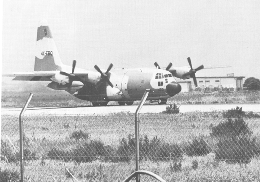
As the Hercules planes roared through the night toward the heart of Africa, the prime minister drove to the Defense Ministry where a loudspeaker linkup was installed to relay the reports from the IDF force landing at Entebbe.
Reflecting back on that night Rabin would later write: "The military transmissions, laconic and dry, heralded the brilliant success of the operation, which was the furthest ever conducted from Israeli territory. It was carried out exactly as planned... When the news came through that the last of our planes had left Entebbe, we drank a toast to the success of the venture. A few hours later people were literally dancing in the streets as a wave of elation swept over Israel."
Assuredly, the Entebbe rescue operation was Yitzhak Rabin's longest night. Arguably, it was his finest hour.


אל תבקש גדלה לעצמך, ואל תחמוד כבוד, יותר לימודך עשה, ואל צצאוה לשלחנם של מלכים, ששלחנך גדול משלחנם, וכתרך גדול מכתרם, ונאמן הוא בעל מלאכתך שישלם לך שכר פעלתך
Non bushkes grandeza, i non kovdisyes onra demasyada de tu meldar az i non deze'es a sus mezas de los reyes, ke tu meza garnde mas ke sus mezas I tu korona grande mas ke sus koronas, i fiel el duenyo de tu ovra ke pagara a ti presyo de tu ovra
Do not seek greatness for yourself and do not chase after honors. Put into practice more than what you have learned, and do not wish for the table of kings (1), because your table is superior to theirs, and your crown higher than theirs, and worthy of faith is your Master (God) to repay the reward of your (good) deeds
Do not wish for the table of kings who, without any work or effort, have the best of everything. The king acquires this crown not because of any special ability, but out of royal descent. But you acquired your table, your greatness and your crown through your own merit.
ארבע מדות באדם. האומר שלי שלי ושלך שלך, זו מדה בינונית. ויש אומרים, זו מדת סדום. שלי שלך ושלך שלי, עם הארץ. שלי שלך ושלך שלך, חסיד. שלי שלי ושלך שלי, רשע
Kuatro kondisyones en el ombre, El ke dizo lo mio mio i lo tuyo tuyo esta kondisyon medyana, I ay dizyentes esta kondisyon de Sedom. Lo mio tuyo i lo tuyo mio Am A'arets, Lo mio tuyo i lo tuyo tuyo bueno. Lo mio mio i lo tuyo mio malo.
People have four characteristics: there is the person who says, "What is mine is mine, and what is yours is yours"; such a person is average (neither pious nor wicked), although some believe that the people of Sodom were like this. Another one says, "What is mine is yours, and what is yours is mine." One who says that is a fool (am ha-aretz). He who says, "What is mine is yours, and what is yours, is yours," is a pious person. But one who says, "What is yours is mine, and what is mine is mine", is wicked